Fragrance Families Explained: The 5 Scent Profiles That Decode Every Bottle
There are over 10,000 fragrances on the market.
If you walk into a department store, that's the wall you're staring at. No map. No order. Just bottles, prices, and a sales assistant trying to get you to spray something on a paper strip. So you sniff a few, get nose-blind by the third one, and walk out with whatever the assistant pushed hardest.
There's a better way. And it starts with five words.
Every fragrance ever made — every bottle on every shelf, designer or niche, cheap or eye-watering — belongs to one of five fragrance families. Once you know the families, the wall stops being chaos. You can rule out 80% of what's out there in 60 seconds and zero in on the bottles that are actually built for your taste. This guide explains all five, how to spot them, and how to use them to stop wasting money on blind buys.
What is a fragrance family?
A fragrance family is a way of grouping fragrances by their dominant character — the overall feeling of the scent.
Think of it like music genres. You don't need to be a musician to know rock from hip-hop from classical. You hear it in a few seconds. Fragrance families work the same way. Sniff a Fresh fragrance and you'll know it's not a Gourmand. Sniff a Woody and you'll know it's not a Floral. The categories are loose, but they're sharp enough that you can use them to navigate.
Most of the fragrance industry uses the Fragrance Wheel — a model developed by perfume taxonomist Michael Edwards in the 1980s. It has four main sectors (Fresh, Floral, Oriental, Woody) with sub-categories inside each. We use a simpler five-family version, because Gourmand has grown so dominant in the last 15 years that it deserves its own slot. You'll see why.
The 5 main fragrance families
1. Fresh
The easiest place to start. Fresh fragrances smell like things you'd actually want to walk through — sea breeze, cut grass, citrus zest, mountain air.
What's in them: lemon, bergamot, grapefruit, lime, mint, basil, cucumber, marine accords, green leaves, tea.
What they feel like: clean, energetic, bright, awake. Fresh fragrances tend to be light and don't sit close to the skin — they project crisply and then fade. Good for hot weather, the office, mornings, or anyone who hates the idea of "smelling like cologne".
Examples to know: Acqua di Giò by Giorgio Armani (the original blueprint). Creed Aventus (technically fresh-fruity-smoky, but the opening is pure pineapple-citrus brightness). Dior Sauvage (fresh-amber crossover). Tom Ford Neroli Portofino. Chanel Allure Homme Sport.
The trade-off: Fresh fragrances usually last the shortest — three to five hours is normal. The molecules are light and disappear fast. If you want all-day projection, this isn't usually the family for you. If you want to smell clean and put-together without anyone choking on your scent in a meeting, it's perfect.
2. Floral
The biggest family by volume — and the most misunderstood. Most people assume "Floral" means "girly old lady perfume". It doesn't.
What's in them: rose, jasmine, tuberose, gardenia, lily, peony, ylang-ylang, orange blossom, violet, iris.
What they feel like: anything from soft and powdery (iris, violet) to loud and intoxicating (tuberose, jasmine), to fresh and dewy (peony, neroli). The Floral family is enormous — it covers a 20-year-old's bright peony spritz and a 60-year-old's dense rose-tuberose statement scent.
Examples to know: Chanel No. 5 (the most famous Floral on earth). Yves Saint Laurent Libre. Dior J'adore. Frédéric Malle Portrait of a Lady (rose so loud it's worn by both men and women confidently). Maison Francis Kurkdjian À la Rose.
The trade-off: Florals can polarise. A heavy white floral (tuberose, jasmine) is a statement scent — some people love it, some find it overwhelming. Lighter florals (peony, neroli) are safer bets. If you've ever sniffed something and thought "this smells like my nan", you probably hit a powdery iris or aldehyde-heavy floral — not a problem with the family, just that specific style.
3. Woody
The backbone of most "sophisticated" or "grown-up" fragrances. Woody scents smell like the things their name suggests — wood, bark, resin, forest floor — but the better ones are dry and elegant, not heavy.
What's in them: sandalwood, cedar, vetiver, patchouli, oud (sometimes spelled oudh), guaiac wood, cypress.
What they feel like: warm, dry, refined, often a bit smoky. Woody fragrances tend to project moderately and last well — six to ten hours is normal. They work year-round, but really shine in autumn and winter, when the air is cold enough to carry the warmth.
Examples to know: Le Labo Santal 33 (the most-copied sandalwood of the last decade). Tom Ford Oud Wood. Creed Royal Oud. Maison Francis Kurkdjian Oud Satin Mood. Dior Homme Intense (iris-cedar — a benchmark men's woody).
The trade-off: Cheap Woody fragrances can smell like furniture polish. Quality matters more here than in any other family — synthetic wood notes can feel harsh, while real sandalwood and aged oud are some of the most beautiful materials in perfumery. Worth testing before committing.
4. Amber (formerly Oriental)
The warmest, richest, heaviest family — and the most divisive. Amber fragrances are the ones you notice from across the room.
What's in them: amber resin, labdanum, benzoin, incense, frankincense, myrrh, vanilla, tonka bean, warm spices (cinnamon, clove, cardamom, saffron).
What they feel like: warm, sweet, spicy, resinous, often a bit smoky. Amber scents are the opposite of Fresh — they sit close to the skin, develop slowly over hours, and project boldly in cold weather. Built for evenings, winter, and confidence.
Examples to know: Tom Ford Tobacco Vanille (the bestselling Amber of the 2020s). YSL Black Opium. Maison Francis Kurkdjian Baccarat Rouge 540 (amber-floral with a saffron heart). Parfums de Marly Layton (amber-gourmand). Guerlain Shalimar (the original 1925 blueprint).
The trade-off: Heavy Ambers can overwhelm. Spray two and you'll get compliments. Spray six and you'll clear a room. Also worth knowing: the industry has mostly stopped calling this family "Oriental" because of the colonial-era baggage in the term. You'll see "Amber" or "Amber Spicy" on most modern bottle descriptions.
5. Gourmand
The newest family, and the one that's exploded in popularity since the early 2000s. Gourmand fragrances smell like food — desserts mostly, but also coffee, chocolate, nuts, and creamy things.
What's in them: vanilla, caramel, chocolate, coffee, honey, almond, pistachio, praline, tonka bean (which has a sweet hay-vanilla scent), milk accords.
What they feel like: sweet, cosy, comforting, indulgent. Gourmand fragrances are usually warm and close to the skin. They've taken over both the men's and women's market in the last decade — Lattafa, Parfums de Marly, By Kilian, Mancera and Tom Ford all have Gourmand bestsellers right now.
Examples to know: Thierry Mugler Angel (the 1992 fragrance that started the whole family — chocolate, caramel, patchouli). Kilian Love Don't Be Shy. Parfums de Marly Layton. Lattafa Yara. Tom Ford Lost Cherry.
The trade-off: Gourmand fragrances can feel too sweet in hot weather and a bit "trendy" if you pick the loudest ones. The Lattafa-style sweet pistachio-vanilla blast is everywhere right now — which means it'll smell dated faster than a classic Woody or Floral. If you go Gourmand, balance is the friend you want — look for ones with a Woody or Amber base to stop them tipping into dessert-cart territory.
How families overlap (the modern blend)
Here's the thing nobody tells you on Day 1: almost no modern fragrance is purely one family.
Dior Sauvage? Fresh-Amber. Baccarat Rouge 540? Amber-Floral with a Woody base. Le Labo Santal 33? Woody-Gourmand. Creed Aventus? Fresh-Fruity-Smoky-Woody. Most of the world's bestsellers sit at the crossover between two or three families, because that's where the most interesting compositions live.
What that means for you: don't expect every fragrance to fit neatly into one box. When a bottle is described as "Amber Woody" or "Floral Gourmand", that's telling you which two families it pulls from. The first word is usually the dominant one. The second is the supporting character.
If you discover you love Amber Woody fragrances, that's a powerful filter. It rules out 80% of the Floral and Fresh markets in one move. You can spend the next year exploring just that lane and never get bored.
How to read a fragrance pyramid
Once you understand families, the next layer is the fragrance pyramid — the way a fragrance unfolds on your skin over time.
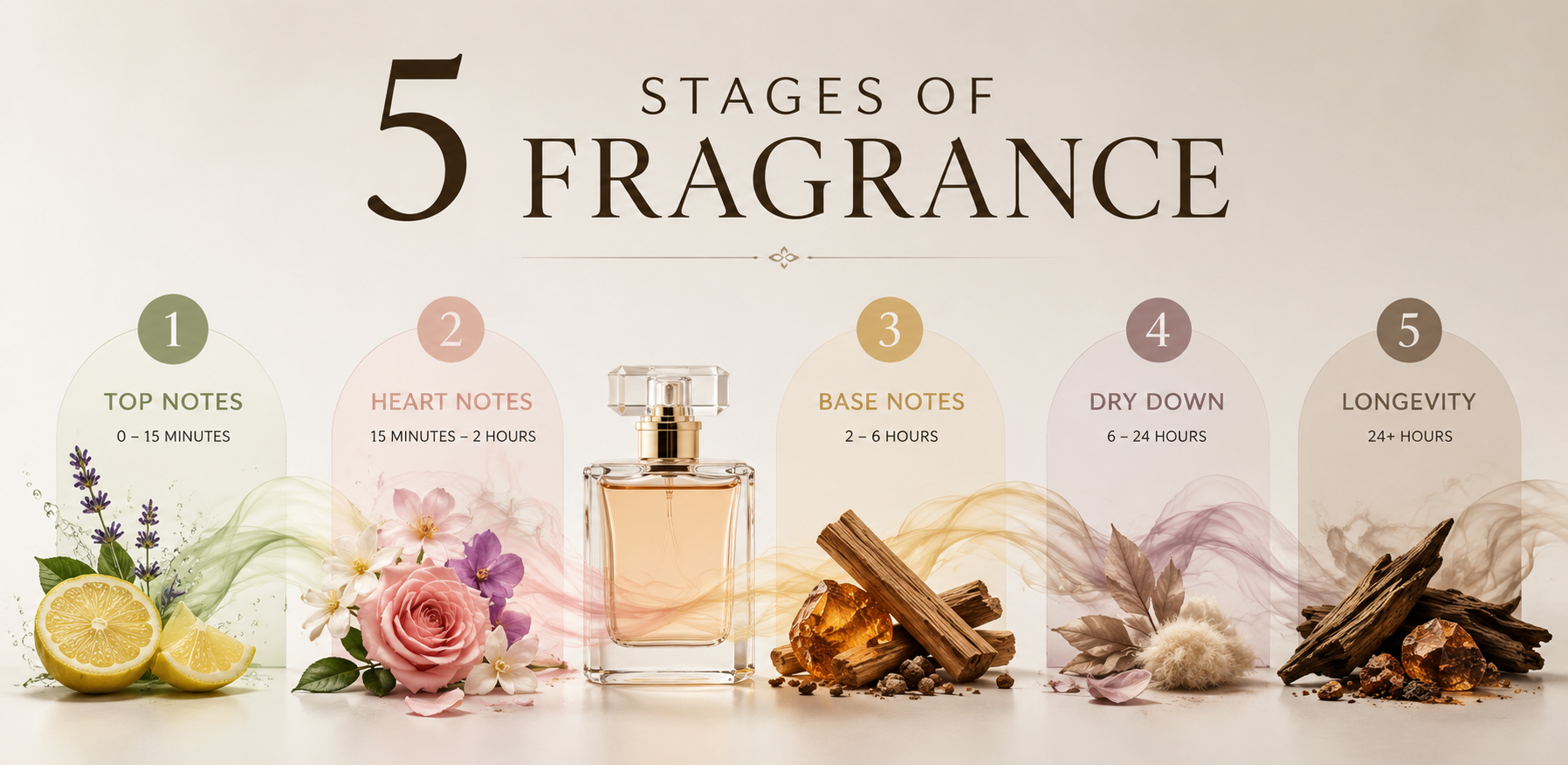
Every fragrance has three layers:
- Top notes — the first 15–30 minutes. Light, volatile molecules. Usually citrus, fresh fruits, green notes, or light spices. These are what you smell when you first spray.
- Heart (or middle) notes — 30 minutes to 3 hours in. The "soul" of the fragrance. Usually florals, fruits, or main spices.
- Base notes — 3 hours onwards, and what stays closest to your skin. Usually woods, ambers, musks, vanillas, oud. These are the dry-down — the part people who hug you will smell.
A fragrance can have Fresh top notes, Floral heart notes, and a Woody base — meaning the family it "belongs to" depends on which layer dominates. Most of the time it's the heart and base. That's why a fragrance can smell completely different in the first 10 minutes than at hour four — you're meeting different layers of it.
When you're trying to identify your family, the dry-down matters most. The first spray is the firework. The hour-four scent is the bottle.
How to find your family without spending £200
You don't need to buy bottles to figure out which family is yours. Three faster routes:
1. Pay attention to smells you already love. Drawn to fresh laundry, sea air, cucumber slices in water? Fresh. Love the smell of a bakery, vanilla candles, a coffee shop? Gourmand. Linger by the rose bed in a garden? Floral. Like the smell of a leather jacket, a woodfire, a library, or your dad's old aftershave? Woody or Amber. These instincts are reliable — your nose has been pattern-matching for decades.
2. Try a discovery set or decants. A bottle is £80–£300. A decant is £4–£12. Buy a few decants across the families you're curious about, wear each for a full day, and you'll narrow your taste in two weeks. This is what fragrance enthusiasts call "sampling" — and it's the single fastest way to stop wasting money.
3. Take a fragrance family quiz. A good quiz sorts you in under a minute using preferences you already know. We built ours specifically around the 5-family model — it asks about smells you like in everyday life, not about random fragrance names you haven't smelled.
The mistake most people make is picking by brand before they know their family. They buy Tom Ford because it's prestigious. They buy Sauvage because they saw the ad. Then the bottle sits unloved because it was never for them in the first place.
Find your family first. Then the brand is just a question of which one inside that family fits your nose and budget.
What to do once you know your family
Once you've identified the family (or two families) you sit in, the fragrance world gets dramatically smaller — and that's a good thing.
You can search "best Woody fragrances 2026" and ignore everything else. You can read reviews and skip past the Florals. You can walk into a department store and ask a sales assistant for "anything heavy on sandalwood and cedar" and they'll actually be able to help, because you've given them a real filter.
You can also start building what fragrance lovers call a wardrobe — a small collection of 3–5 bottles that cover different moods, seasons, and occasions. Most wardrobes are built around one main family (your home base) with one or two bottles from a complementary family for variety. A Woody main, a Fresh for summer, an Amber for evenings. Or a Floral main, a Gourmand for date nights, a Fresh for the gym.
That's the goal. Not one signature scent for life. A small, deliberate collection — built around the families you actually love.
Want monthly fragrance discovery without the £200 blind buys? The Vault Insider membership is built for exactly this — start for £9 (then £19/mo), members get every drop 48 hours early, and it's love-it-or-it's-free with a 30-day money-back guarantee, cancel anytime. Start for £9 →
Read this and still not sure which scent profile fits you? Take the 60-sec scent quiz → — we'll match you to one of 5 fragrance families.