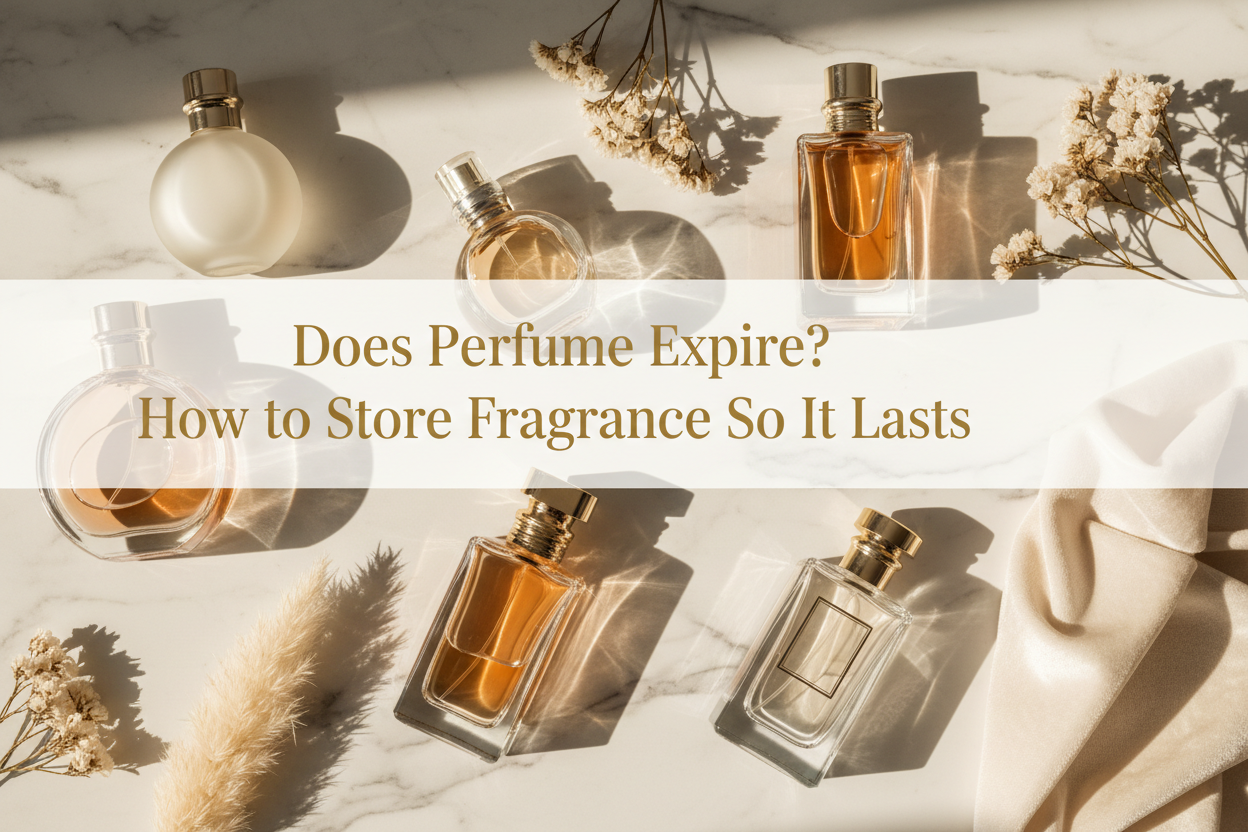
Does Perfume Expire? How to Store Fragrance So It Lasts
You spent good money on a bottle. It smelled incredible the day you bought it. Then six months later you spray it and something's off. Flatter. A bit sour at the top. Not the scent you fell for.
So here's the question we get asked more than almost any other: does perfume actually expire? Short answer, yes. But not the way food does. There's no date stamped on the bottle, and it doesn't go bad overnight. It fades and shifts slowly, and how you store it decides whether that takes eight months or eight years.
We built R3VIVE around trying fragrance before you commit, which means we handle a LOT of bottles and decants. This guide is everything we've learned about how long perfume really lasts, how to spot when it's turned, and the simple storage habits that keep your collection smelling the way it should.
So does perfume actually expire?
Yes. A perfume is mostly alcohol and fragrance oils, and both change over time as they react with the air, light and heat around them.
The technical word is oxidation. In plain terms: oxygen slowly gets at the oils and rearranges them. The delicate top notes, the fresh citrus and bright bits you smell in the first few minutes, break down first. The heavier base notes hang on longer. That's why an old bottle can smell harsh and thin at the opening but still have something recognisable underneath.
It's a gradual slide, not a switch. Your perfume won't be perfect one morning and ruined the next. It quietly loses its sparkle over months and years. The good news is you have a lot of control over how fast that happens.
How long does perfume last?
This is where people want a single number, and there isn't one. It depends on whether the bottle is opened, what's in it, and how you keep it. Here's the honest range.
Unopened and sealed
Three to five years is the safe bet, and plenty of bottles go well past that. Sealed, with the cap on and ideally still in the box, the juice is protected from its two biggest enemies: air and evaporation. If you're a bit of a collector and you like to stock up, an unopened bottle stored properly will wait for you.
Opened and in use
Once you've opened it and you're spraying regularly, think two to three years at its best. Some hold up for four or five. Every spray pulls a little air into the bottle, and that air keeps the oxidation ticking along. The more empty space above the liquid, the faster it ages, which is why that last quarter of a bottle often smells weaker than the first.
It depends on the scent too
Not all fragrances age at the same speed. Light, fresh, citrusy and aquatic scents tend to turn quicker because so much of their character lives in those fragile top notes. Rich, heavy scents built on amber, oud, resins, woods and vanilla are far more stable and can smell great for years. So your summer citrus splash has a shorter clock than your deep winter oud. Worth knowing when you decide what to stock up on.
What makes perfume go off
Three things do most of the damage. Get these under control and you've won most of the battle.
Heat
Warmth speeds up every chemical reaction in the bottle, including the ones you don't want. A perfume kept somewhere warm ages noticeably faster than one kept cool. This is the big reason bathrooms and windowsills are such bad homes for fragrance.
Light
Sunlight, and UV in particular, breaks fragrance molecules apart and can change the colour of the liquid. That's the whole point of those tinted and boxed bottles. A clear bottle sat in daylight is getting cooked slowly, even if the room feels fine to you.
Air
Every time you open the bottle, oxygen gets in. You can't avoid this if you actually want to wear the thing, but it's why a half-empty bottle ages faster than a full one, and why decanting into a smaller container can genuinely help preserve what's left.
Humidity is a smaller fourth factor, mostly because the damp swing of a bathroom drags the temperature and moisture up and down all day. Steady conditions are what you're after.
How to tell your perfume has turned
You don't need a lab. Your nose and your eyes will tell you. Look for these three signs.
The smell changes. This is the clearest one. A turned perfume often smells sour, sharp or slightly metallic at the top, almost like vinegar, where it used to smell fresh and bright. The opening is where oxidation shows up first.
The colour changes. Clear or pale juice going noticeably darker, yellow, or cloudy is a strong hint. A little deepening over years is normal for some scents, but a sudden or dramatic shift is a warning.
The performance drops. If a fragrance that used to last all day now vanishes in an hour, or smells weak and flat straight out of the bottle, the good stuff has degraded.
One of these alone might mean nothing. Some scents naturally darken a touch with age and smell perfectly fine. But two or three of these together? It's had its day.
How to store perfume so it lasts
Here's the part that actually saves your bottles. None of it is complicated.
Give it a cool, dark, steady home
A bedroom drawer, a wardrobe shelf or a cupboard is perfect. You want somewhere the temperature stays roughly the same all year and no direct light gets in. Away from radiators, away from windows. Boring and stable is exactly what fragrance loves.
Keep the box
If you've still got the original box, use it. It's not just packaging. It blocks light completely and adds a little insulation from temperature swings. The fanciest bottle on an open shelf is worse off than a plain one tucked back in its box.
Skip the bathroom and the windowsill
We know, the bathroom is where you get ready, so it feels like the natural spot. But the shower turns it into a sauna twice a day, and that heat and humidity swing is brutal on fragrance. The sunny windowsill looks lovely and does the same damage with light. Both are the two most common storage mistakes, and both are easy to fix.
Leave the cap on and don't shake it
Keep the cap firmly on between wears so less air sits in contact with the juice. And there's no need to shake a perfume. Shaking just whips more air through it, which does the opposite of what you want.
A word on decants and samples
Smaller containers are actually a smart way to protect a fragrance you love. Decanting some of a big bottle into a little atomiser means the main bottle gets opened less and stays fuller for longer, which slows its ageing. The trade-off: a tiny sample vial has a lot of air relative to liquid, so use samples within a few months rather than saving them for years. For trying scents before you buy, that's no problem at all, since the whole point is to wear them soon.
Does concentration change how long it lasts?
A little, yes. Higher concentration fragrances, parfum and extrait, carry more oil and less alcohol, and that oil-rich mix tends to be a bit more stable in the bottle over time. Lighter eau de toilettes lean more on those fragile top notes, so they can lose their edge sooner. It's a minor factor next to how you store it, but if you're choosing something to keep for the long haul, the richer concentrations have a slight head start. (If parfum versus EDP versus EDT is new to you, we've got a full guide on that.)
Can you save a perfume that's starting to turn?
Once oxidation has happened, you can't reverse it. There's no trick that turns a soured bottle back into the scent it was. But if you catch a fragrance early, when it's only just starting to lose its edge, you can slow the slide and still get plenty of wear out of it.
Move it somewhere properly cool and dark straight away, and cap it tightly between uses. If the bottle is more than half empty, decant what's left into a smaller atomiser so there's less air sitting on top of the juice. A little travel spray, filled close to the top, ages far slower than a big bottle with a lot of empty space.
And if a fragrance is only mildly off, one that's flattened a bit rather than gone properly sour, spraying it onto a scarf, a jacket or your clothes rather than your skin can be a nice way to use it up. You get the scent without asking degraded juice to perform its best on your skin all day. When it smells clearly sour or does anything odd to your skin, though, let it go. A perfume that's turned isn't worth chasing.
Storing perfume when you travel
Travel is where a lot of bottles take a beating. A fragrance rattling around a hot car or baking in a suitcase in the sun is getting the exact heat-and-light treatment you spend the rest of the year avoiding.
Keep travel bottles out of direct sun, don't leave them in a car on a warm day, and pack them in the middle of your bag where the temperature is steadier. This is another spot where a small decant earns its keep. Take a little atomiser of your favourite rather than the full bottle, and if it gets knocked about or overheated, you've risked a few millilitres instead of the whole thing.
The simple version
Perfume expires, but slowly, and mostly on your terms. Keep it cool, dark and steady, leave it in the box, stay out of the bathroom, and a good bottle will smell right for years. Trust your nose: sour, dark or flat means it's gone. Everything else is just giving your fragrance the boring, shady, stable home it quietly wants.
Frequently asked questions
Does perfume expire? Yes, but gradually. It reacts with air, light and heat and slowly loses its top notes. Unopened bottles stay good for roughly three to five years, often longer. Once opened and in use, expect two to three years at its best. There's no overnight cut-off, it just fades and shifts over time.
How long does perfume last once opened? Around two to three years for most fragrances in regular use, sometimes four or five if you store them well. Fresh citrus and aquatic scents turn faster because their character sits in fragile top notes. Rich, heavy scents last longer.
How long does unopened perfume last? Three to five years is the safe range, and many last well beyond it. Sealed and boxed in a cool dark spot, the juice is protected from air and evaporation, the two things that age it fastest.
How can I tell if my perfume has gone bad? Check three things. The smell (sour, sharp or metallic at the top), the colour (noticeably darker or cloudy), and the performance (fading much faster than it used to). One sign might be nothing. Two or three together means it's turned.
Where is the best place to store perfume? Somewhere cool, dark and steady: a drawer, a wardrobe shelf or a cupboard away from radiators and windows. Keep it in the original box to block light. Avoid the bathroom and windowsills.
Is it bad to keep perfume in the bathroom? Yes, it's one of the worst spots. Every shower swings the heat and humidity up and down, which breaks fragrance down faster. A bedroom drawer is a far better home.
Can you use expired perfume? You can, and it usually won't harm you, though turned fragrance can sometimes irritate sensitive skin. The bigger issue is that it won't smell how it should. If it smells off or reacts on your skin, stop using it.
Does keeping perfume in the fridge help? A cool, stable fridge can help, and some collectors use a dedicated one. A normal kitchen fridge gets opened all day and holds food smells, so it isn't ideal. A cool dark drawer does the same job with none of the fuss. Don't freeze it, and let chilled perfume warm up before wearing.
Want monthly fragrance discovery without the £200 blind buys? The Vault Insider membership is built for exactly this. Start for £9 (then £19/mo), members get every drop 48 hours early, and it's love-it-or-it's-free with a 30-day money-back guarantee, cancel anytime. Start for £9 →
Read this and still not sure which scent profile fits you? Take the 60-sec scent quiz → — we'll match you to one of 5 fragrance families.