How to Choose a Signature Scent (Without Burning £200 on a Blind Buy)
Most people pick fragrance wrong.
They walk into a department store, get blasted by a sales counter, spray six things on paper, pick the one with the prettiest bottle, and walk out £200 lighter. Three weeks later, that bottle is gathering dust on the shelf — too heavy for summer, too sharp on their skin, or just not… them.
We see it every week on Whatnot. Someone tells us they "hate fragrance" and we get them to test five scents from different families. Suddenly they're emotional about a Tom Ford gourmand or a Dior tobacco. They didn't hate fragrance. They'd just never been matched properly.
This guide walks you through exactly how to find a scent that feels like yours — the way you'd choose a watch or a great pair of shoes. Slow. Considered. Tested. No blind buys. No regret bottles.
Here's the system.
What "Signature Scent" Actually Means in 2026
The old idea of a signature scent was a single bottle you wore for life. Cary Grant and his Acqua di Parma. A grandfather with one cologne for fifty years.
That world is gone. The fragrance industry releases over 2,000 new launches a year. Skin chemistry varies. Weather varies. Occasions vary. Pinning yourself to one bottle forever isn't romantic — it's limiting.
In 2026, a signature scent is the one people associate with you most. It might be the only fragrance you own, or the anchor in a small wardrobe of three to five. It's the scent your partner notices when you walk into the room. The one a friend smells on a jumper a year later and says, "this is you."
The job isn't to find the perfect fragrance. It's to find one — or a small set — that consistently feels true.
Why Most People Get It Wrong
Three reasons, in order of how often we see them.
One: they buy on smell alone, not skin. A fragrance in the bottle and a fragrance on your wrist are not the same thing. Top notes (the first 15 minutes) are the loudest and the least representative. What you actually wear is the dry-down — the heart and base notes that emerge after 1–2 hours and sit on your skin all day. If you've never smelt a fragrance after 4 hours on your own skin, you don't know it.
Two: they shop by brand, not nose. Brand loyalty is a marketing trick. Dior makes incredible fragrances and also makes ones that smell like nothing. Tom Ford has masterpieces and misses. The fragrance world is fractured across thousands of houses — designer, niche, indie, artisanal — and the best one for you might be one you've never heard of.
Three: they confuse "popular" with "right for me." Aventus by Creed is one of the best-selling masculine fragrances of the last 20 years. It also smells loud, smoky, and sweet — which works on some people and turns to baby powder on others. Just because a scent is popular doesn't mean it's yours.
Step 1 — Learn the Fragrance Families
There are dozens of ways to classify fragrance. We use five families because they map cleanly to how people actually wear scent. Almost every fragrance you'll ever try sits in one of these.
Fresh. Citrus, aquatic, green, ozonic. Lemon, bergamot, sea salt, mint, vetiver in its cleaner form. Think Acqua di Gio, Sauvage EDT, Light Blue. Crisp, energetic, light. Office-safe. Summer-friendly.
Warm. Amber, vanilla, tonka, benzoin, gourmand spices. The "hug in a bottle" family. Think Black Opium, Tobacco Vanille, Spicebomb, Angels' Share. Cosy, sweet-but-not-sugary, autumn and winter dominant.
Woody. Sandalwood, cedar, oud, cashmere wood, dry vetiver. Sophisticated, grounded, often unisex. Think Le Labo Santal 33, Tom Ford Oud Wood, Aventus in its drydown. Versatile across seasons.
Floral. Rose, jasmine, peony, tuberose, ylang-ylang. Not just feminine — modern florals like PdM Delina Exclusif or Tom Ford Black Orchid are worn by everyone. Romantic, expressive, often statement.
Explorer. Niche, weird, off-piste. Animalic notes, smoke, leather, unusual accords. Roja Elysium, By Kilian Black Phantom, anything from Nasomatto. For people who want a scent nobody else in the room is wearing.
If you've never thought about which family suits you, that's the first thing to fix. Most people fit two — and ignoring the other three saves you a lot of bad blind buys.
Step 2 — Match Scent to Season and Setting
This is where signature wardrobes beat single-bottle signature scents.
Heat amplifies fragrance. A heavy amber that smells stunning in December can feel like a wet blanket in July. Cold weather mutes lighter fresh and aquatic scents until they almost disappear before lunchtime.
A simple rule of thumb:
- Spring/Summer: Fresh, light florals, aquatic, citrus, green. Lighter concentrations (EDT) often perform better in heat.
- Autumn/Winter: Warm, woody, spicy, gourmand. Higher concentrations (EDP, Parfum) hold up against cold.
- Office: Whatever family you love, but turned down. Three sprays max. No oud bombs. Avoid the "sillage monster" school.
- Date night: Whatever makes you feel most confident. This is where statement scents earn their money.
- Big occasions: A scent you've worn enough to know how it develops, and that has an emotional anchor.
You don't need a different bottle for each. But knowing what role a fragrance is playing changes how you choose it.
Step 3 — Test Properly (Skin, Not Paper)
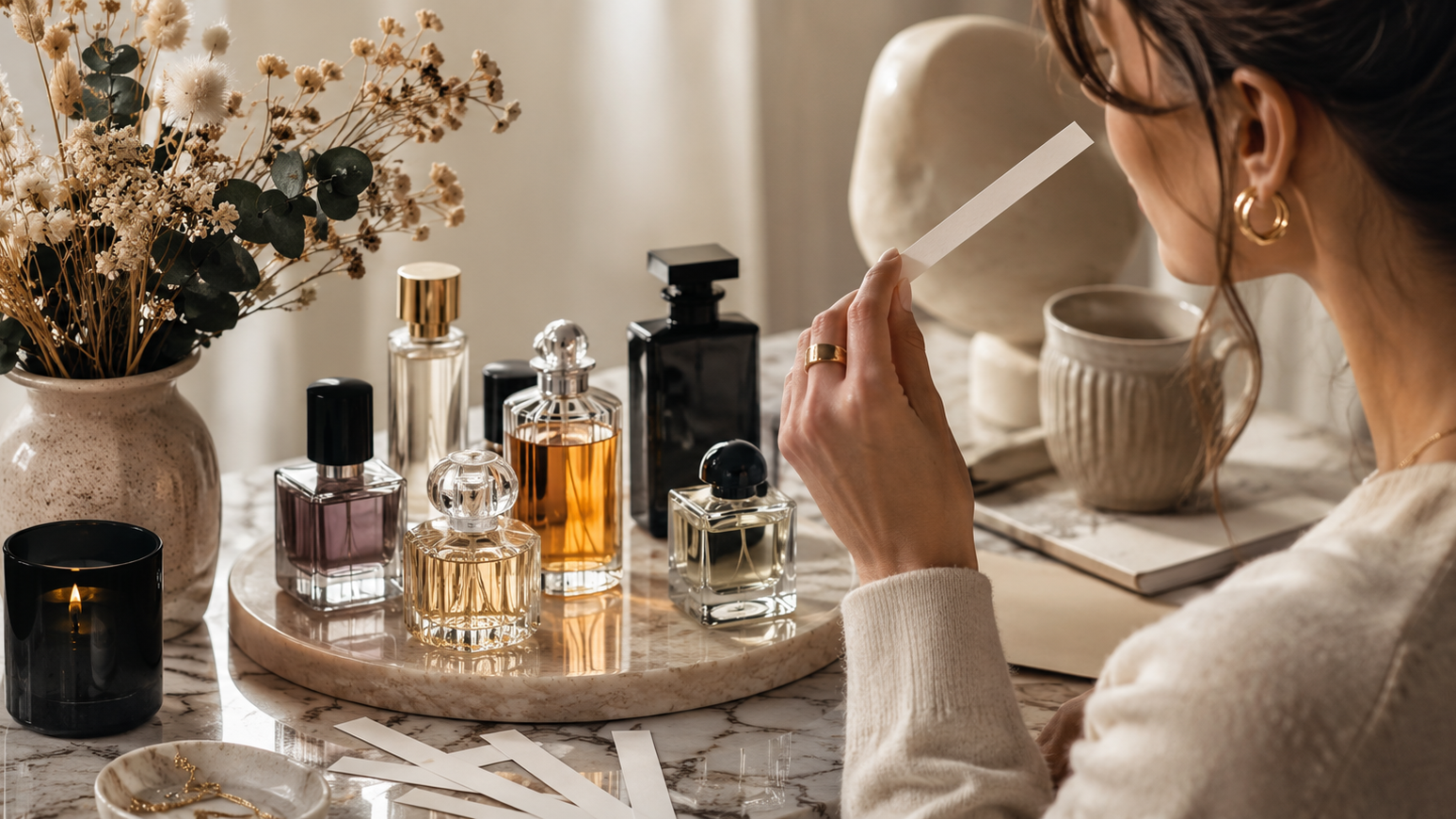
Department store paper strips are useless past the first 30 seconds. They show you the top notes and nothing else.
To actually test a fragrance, you need to wear it on your skin for the full life of the wear. Here's the proper method:
- One spray on your inner wrist. Don't rub. Let it dry naturally.
- Smell at 0 minutes, 30 minutes, 2 hours, 4 hours, and 8 hours. Notes change. The 4-hour smell is what you'll actually wear most.
- Test no more than two fragrances at once (one per wrist). Beyond that, your nose fatigues and everything starts smelling similar.
- Test on a day with normal weather and a normal meal. Spicy food, alcohol, and heat all change how a fragrance reads on you.
- Get a second opinion from a partner or friend at the 4-hour mark — they smell you the way the world does.
The cheapest way to test properly is a decant — a 5–10ml sample of the original fragrance, usually £3–£8. A full week of testing for under a tenner beats a £200 mistake.
Step 4 — Wear It for a Week Before Committing
If a fragrance still excites you on day 7, you've found something real.
This is the rule that saves most people the most money. Three things change between day one and day seven:
- You stop smelling it on yourself. Olfactory adaptation — your nose tunes out a scent it's worn repeatedly. If you can still catch it after a week, it's strong enough to last.
- You see how it performs across different days. Hot day, cold day, gym day, work day, late-night day. A signature scent has to work across your actual life, not just the perfumery counter.
- You get reactions from people who don't know you're testing. Compliments at work, your partner pulling you in for a sniff at the door, a stranger asking what you're wearing — these are the real votes.
If after seven days you're still excited to spray it on the morning of day eight, you've found one. Buy the bottle. Wear it for a year. Then test the next one.
Step 5 — Build a Mini Wardrobe Instead
Once you've found your first signature, don't stop. The most rewarding way to live with fragrance isn't a single bottle — it's a small, intentional rotation.
A starter wardrobe most fragrance lovers build looks something like this:
- One warm-weather workhorse — fresh, light, daytime.
- One cold-weather workhorse — warm or woody, all-day.
- One statement scent — niche, unusual, occasion-only.
- One office scent — quiet, polished, never offensive.
- One comfort scent — the one that reminds you of someone or somewhere.
Five fragrances, rotated thoughtfully, will out-perform a wardrobe of 30 bottles you bought once and never wore. The discipline isn't owning more — it's choosing better.
The Real Cost of Getting This Right
Here's the maths most people don't do.
A blind buy on a £200 designer fragrance you wear twice and abandon = £100 per wear.
A £4 decant tested for a week, followed by a £180 informed purchase you wear 200 times in two years = 90p per wear.
The difference isn't really about money. It's about ending up with fragrances you actually love instead of bottles you tolerate.
Frequently Asked Questions
Do I actually need just one signature scent?
No. The idea of a single "signature scent" is romantic but outdated. Most people who love fragrance build a small wardrobe of 3–5 scents — one for warm weather, one for cold, one for the office, one for date nights, one for big occasions. Start with one anchor scent that feels like you, then expand.
How long should I wear a fragrance before deciding to buy it?
At minimum, three full wears across different days. A fragrance changes over 6–8 hours on your skin, and it smells different on different days depending on weather, what you've eaten, and your skin's pH. We recommend a 7-day test if you can — that's why decants exist. £4 to wear something for a week beats £200 on a bottle you'll never touch again.
Can men and women share the same signature scent?
Absolutely. The "for men" or "for women" labels are marketing, not chemistry. Some of the most-worn fragrances in the world — Tom Ford Tobacco Vanille, Baccarat Rouge 540, Le Labo Santal 33 — are openly unisex. If you smell something on a partner or friend and love it on them, try it on yourself. Skin chemistry will change it anyway.
What's the difference between EDP and EDT for signature wear?
EDP (Eau de Parfum) has a higher concentration of fragrance oils (15–20%) than EDT (Eau de Toilette, 5–15%). EDP lasts longer, projects more, and develops more on skin — usually the better choice for a signature scent. EDT is lighter, fresher, and often better for hot weather or office wear.
Should my signature scent change with the seasons?
Ideally, yes. Heat amplifies fragrance — a heavy oud that smells stunning in December can feel suffocating in July. Most fragrance lovers run a two-bottle minimum: fresh and light for warm months, warm and woody for cold ones. One bottle year-round is fine — just expect different performance.
How many sprays of fragrance should I wear for daily use?
Three to five sprays for daytime, four to six for evening. Pulse points — neck, behind the ears, inner wrists, chest — hold scent best. Don't rub your wrists together; it crushes the top notes. The rule: people should notice you when they hug you, not when you walk into the room.
Why does my fragrance smell different on me than in the bottle?
Your skin chemistry — pH, natural oils, hydration, even diet — interacts with the fragrance and changes how it develops. Two people can wear the same scent and smell completely different. That's why testing on skin matters more than sniffing the bottle.
Are designer or niche fragrances better for a signature scent?
Neither is automatically better. Designer fragrances are widely recognised and often well-blended. Niche houses usually have higher-quality raw materials and more unusual compositions — but cost £200–£400 a bottle. The right answer is what fits your nose and your budget. Smell first, brand second.
Closing — Slow Down, Test Smart, Build Slowly
The fragrance industry wants you to buy fast. They want the impulse purchase at the till, the gift-set upsell, the new-launch hype.
The people who end up loving fragrance the most do the opposite. They smell wide, test deep, and commit slowly. They build a wardrobe of five great bottles instead of a graveyard of twenty mediocre ones. They learn their nose.
If you take one thing from this guide: stop blind-buying full bottles. Test for a week before you commit. Decants exist for exactly this reason — they make the discovery cheap, low-risk, and honest.
The rest is just time and curiosity.
Want monthly fragrance discovery without the £200 blind buys? The Vault Insider membership is built for exactly this — start for £9 (then £19/mo), members get every drop 48 hours early, and it's love-it-or-it's-free with a 30-day money-back guarantee, cancel anytime. Start for £9 →
Read this and still not sure which scent profile fits you? Take the 60-sec scent quiz → — we'll match you to one of 5 fragrance families.