Article: How to Test Perfume Properly (and Stop Wasting Money on Bottles You Never Wear)
How to Test Perfume Properly (and Stop Wasting Money on Bottles You Never Wear)
Almost everyone has one. The bottle at the back of the cupboard that seemed brilliant in the shop and wrong by Tuesday. Three sprays used, ninety-odd quid gone.
Here's the thing though. It usually isn't the fragrance that failed. It's the test.
Most of us buy perfume the same way: walk into a bright shop, get handed four paper strips in ninety seconds, pick whichever one still smells nice by the time we reach the till. That process is designed to move stock, not to help you find something you'll wear for years.
So we want to show you how to test properly. What paper tells you and what it can't. Why your nose gives up after the third spray. How long you actually need to wait before you know. None of it is complicated, and it costs nothing except patience.
Get this right and the expensive mistakes mostly stop.
Why the shop is the worst place to make the decision
Walk into any fragrance hall and take a breath. You're already smelling forty products at once. The air is saturated before you've tried anything.
Then there's the lighting, the mirrors, the assistant standing at your shoulder, and the quiet pressure to have an opinion quickly. None of that helps your nose. All of it helps the sale.
And the biggest problem is time. A fragrance takes hours to show you what it is. You'll typically be given about two minutes.
That's the gap where the money gets wasted. You're buying the opening. You'll be wearing the ending.
Use the shop for shortlisting, not deciding
Reframe what a shop visit is for. It's a filter, not a verdict.
Your goal in there is to walk out with one or two candidates on your skin, not a bag. Everything else happens later, at home, in your normal clothes and your normal day.
Paper strips versus skin
Both have a use. People go wrong by treating them as the same test.
What paper is good for
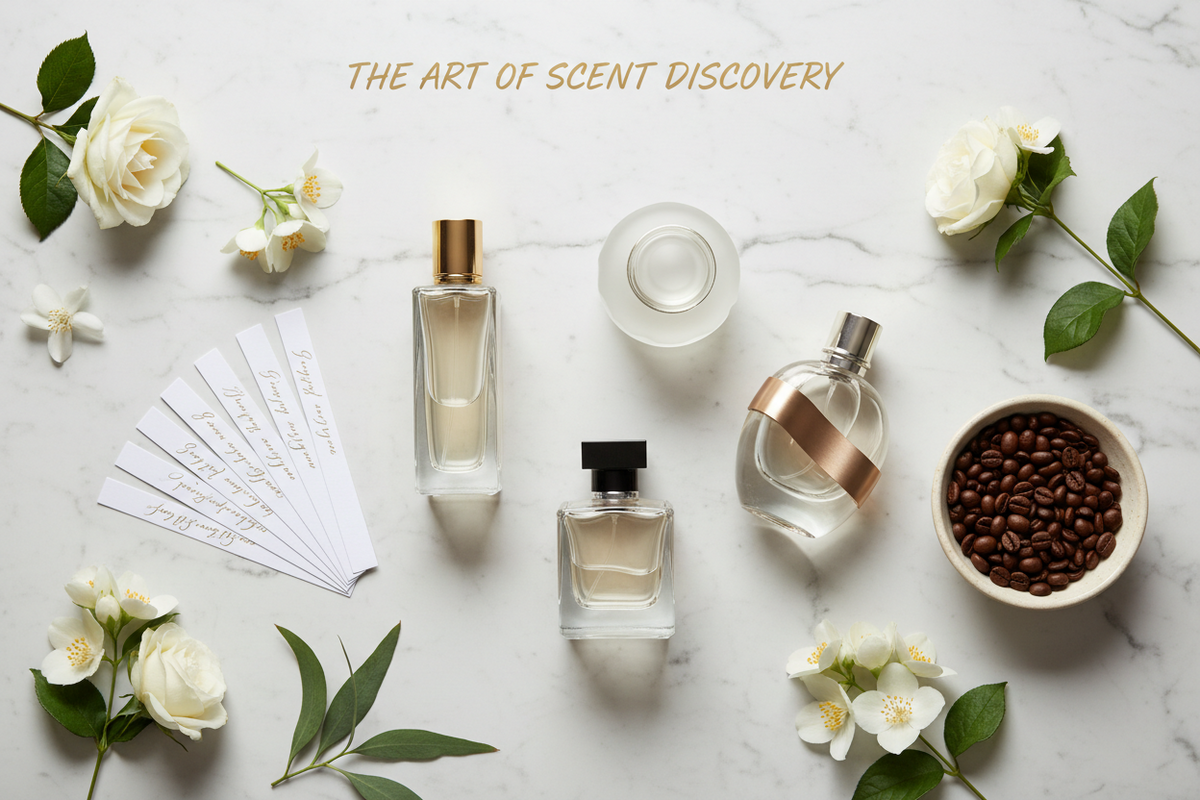
A paper strip, sometimes called a blotter or a mouillette, gives you the shape of a fragrance in about thirty seconds. Sweet or dry. Fresh or heavy. Floral or woody.
That's genuinely useful. You can rule out four scents that were never going to work without burning a single patch of skin. Paper is your first sieve.
What paper can't tell you
Paper has no body heat, no oils, no sweat and no pH. It's a flat surface with no interest in you at all.
So a fragrance on card is the manufacturer's version. A fragrance on your wrist is your version, and those can differ more than people expect. The same amber can read clean and dry on one person and sticky-sweet on another.
If a scent survives the paper test, put it on your arm. Not before, or you'll run out of skin by the third bottle.
One more thing about paper
Write the name on the strip before you spray it. Every single time.
You think you'll remember. You won't. Four unlabelled strips in a handbag is how people end up buying the wrong thing entirely.
Nose fatigue, and the coffee bean myth
Your sense of smell is built to notice change, not to catalogue things. Sit in a room with a strong scent for a few minutes and you stop registering it. That's your brain filtering out background noise so it can spot anything new.
Same thing happens when you test fragrance. After roughly three scents, everything starts merging into one warm, vaguely sweet blur. This is olfactory fatigue, and it's not a sign of a bad nose. It's a normal, healthy one doing its job.
The practical limit is two fragrances per visit. Three if you're spreading them across both arms and you've had a break between them.
Sorry, the coffee beans don't work
You'll see a bowl of coffee beans on nearly every fragrance counter. Sniff between scents to reset the nose, so the story goes.
It doesn't hold up. Research comparing coffee to plain unscented air found no meaningful difference in how well people could smell afterwards. Coffee is simply another strong smell, so you're adding to the load rather than clearing it.
What does help is boring. Step outside. Get some fresh air for five minutes. Or smell the crook of your own elbow, since your brain treats your own skin as neutral and it gives your nose something familiar to recalibrate against.
The three stages, and how long each one takes
Fragrance is built to unfold over time. Understanding the timing is most of what separates a good test from a bad one.
The opening lasts roughly ten to thirty minutes. Bright citrus, herbs, light spice, plus the alcohol still evaporating. It's loud and it's temporary. Every fragrance smells its sharpest here.
The heart runs from around thirty minutes to two hours. Florals, warmer spice, fruit. This is the character of the scent, the part the perfumer built the thing around.
The base takes over after two to three hours and stays for the rest of the day. Woods, musk, amber, vanilla, resins. Heavy molecules that evaporate slowly.
Here's why that matters for your wallet. The base is what you'll smell on yourself most of the time, what clings to your coat, and what other people notice when you hug them. It's roughly eighty percent of your wearing experience.
And it's the part almost nobody tests before buying.
The four-hour rule
Don't make a decision before hour four. That's the whole rule.
Spray it, walk away, do something else. Check at thirty minutes, at two hours, at four. If you still like it at four hours, you've got something worth considering.
Plenty of fragrances are wonderful at minute one and tiresome by hour three. A few are the opposite, opening awkwardly and turning gorgeous once they settle. You only find out by waiting.
How to actually apply it during a test
Small things, but they change the result.
One or two sprays, no more. You're testing the scent, not fumigating yourself. Over-applying makes almost anything unpleasant and it also wrecks your ability to judge the second candidate.
Six inches from the skin. Close enough to land properly, far enough to spread rather than pool in one wet spot.
Pulse points work, but not because of magic. Wrists, inner elbow, neck and chest are warm areas, and warmth speeds up evaporation so the scent lifts and travels. That's the entire mechanism. No mystical circulation involved.
Don't rub. This one's worth repeating because so many people do it automatically. Rubbing your wrists together creates heat and friction that burns off the top notes faster and can flatten the opening. Spray and leave it. The advice to rub comes from an era of dabbing parfum from a stoppered bottle, and it never applied to sprays.
Keep the two candidates apart. One per arm, minimum. Two scents on the same wrist is a third scent neither of you asked for.
Test it in your real life, not a shop
This is the step that separates people who like their collection from people who own three regrets.
A fragrance behaves differently depending on where you wear it. Temperature, humidity, what you're doing, what you're wearing. A warm shop in August makes heavy sweet scents feel suffocating. The same bottle on a cold December morning can be perfect.
So take the sample home and wear it properly. To work. On the school run. Out for dinner. Give it a full day.
Three questions to ask yourself at the end of it:
Did you still like it at 4pm, or had you stopped noticing? Did anyone say anything? And did you reach for it again the next day without thinking about it?
That last one is the real test. Fragrances you love get picked up automatically. Fragrances you merely admired sit on the shelf.
Where samples and decants come in
You can't do a proper multi-day test with a paper strip and a memory. You need the actual liquid, in a small amount, for less than the price of a night out.
That's what samples and decants are for. A few millilitres of the genuine fragrance, enough for a week of real wear, for a few pounds instead of a few hundred. It turns an expensive gamble into a cheap experiment.
The one thing to check is what you're being sold. A decant should be the real fragrance transferred from a genuine bottle. If a seller won't say what it's decanted from, that tells you something.
When to listen to reviews, and when to close the tab
Reviews are useful for facts and useless for verdicts.
Use them to find out what family a fragrance belongs to, what notes are in it, which house made it, roughly how it's positioned. That's information, and it helps you narrow a shortlist before you set foot in a shop.
What you can't outsource is the fit. Every reviewer is describing their own skin, their own climate and their own nose. Comments about longevity are especially shaky, since a scent that lasts nine hours on oily skin can vanish in three on dry skin.
The comment sections are also full of people who've spent a lot of money and would very much like to be right about it. That's human, but it isn't neutral.
Read for the map. Decide on your own arm.
A quick pre-purchase checklist
Before you hand over the card, run through this:
- You've had it on skin, not just paper
- It's been on for at least four hours
- You've smelled it in normal temperature, not a heated shop
- You tested two fragrances that day at most
- You didn't rub it in
- You've worn it in front of people whose reactions you trust
- You'd choose it again tomorrow morning without deliberating
Miss two or three of those and you're gambling. Not always badly, but gambling.
Frequently asked questions
How do you test perfume properly?
Spray it on skin rather than paper, leave it alone, and wait at least four hours before deciding. Stick to one or two fragrances per visit and keep them on separate arms. The first ten minutes are mostly alcohol and top notes, so they tell you very little about what you'll actually wear.
Why does perfume smell different after an hour?
Because it's built in layers that evaporate at different speeds. Citrus and herbs go first, the floral or spiced middle takes over for a couple of hours, then the heavy base materials sit on your skin for the rest of the day. Nothing has gone wrong. You're just reaching the part that was always going to last.
How many perfumes can you test at once?
Two. Three at a stretch if you spread them across both arms with a break in between. Beyond that your nose stops separating them, which is why people leave a department store unable to recall a single scent they tried.
Do coffee beans reset your sense of smell?
No. Studies comparing coffee to plain air found no advantage, and coffee is a strong smell in its own right, so you're adding to the pile rather than clearing it. Fresh air outside works better, or sniffing your own sleeve.
Should you test perfume on paper or skin?
Both, for different jobs. Paper gives you the rough shape in thirty seconds so you can rule out the obvious misses. Skin tells you how it behaves with your warmth and oils. Anything that passes the paper test should go on your arm before you spend money.
Why should you not rub your wrists after spraying perfume?
Rubbing creates heat and friction, which burns off the lightest top notes faster and flattens the opening. The habit comes from dabbing parfum in the days before atomisers. With a spray, one press and leave it.
How long should you wait before buying a perfume?
Four hours minimum, a full day ideally. That's when you find out whether it gives you a headache by mid-afternoon and whether anyone reacts to it. If someone is pushing you to decide in ten minutes, come back another day.
Are perfume samples and decants worth buying?
For most people they're the cheapest insurance going. A few pounds buys you a week of real wear, against a hundred pound bottle used twice. Just check you're getting genuine juice decanted from a real bottle, not an unnamed copy.
Does perfume smell different in winter and summer?
Yes, more than people expect. Heat speeds up evaporation so scents project harder and burn through faster. Cold slows everything down, which is why heavy sweet fragrances that feel suffocating in July can be lovely in December.
Can you trust perfume reviews online?
Use them for facts, not verdicts. They'll tell you the notes, the family and the house. They can't tell you how it sits on your skin, and longevity comments are the least reliable part of any review.
Want monthly fragrance discovery without the £200 blind buys? The Vault Insider membership is built for exactly this. Start for £9 (then £19/mo), members get every drop 48 hours early, and it's love-it-or-it's-free with a 30-day money-back guarantee, cancel anytime. Start for £9 →
Read this and still not sure which scent profile fits you? Take the 60-sec scent quiz → — we'll match you to one of 5 fragrance families.