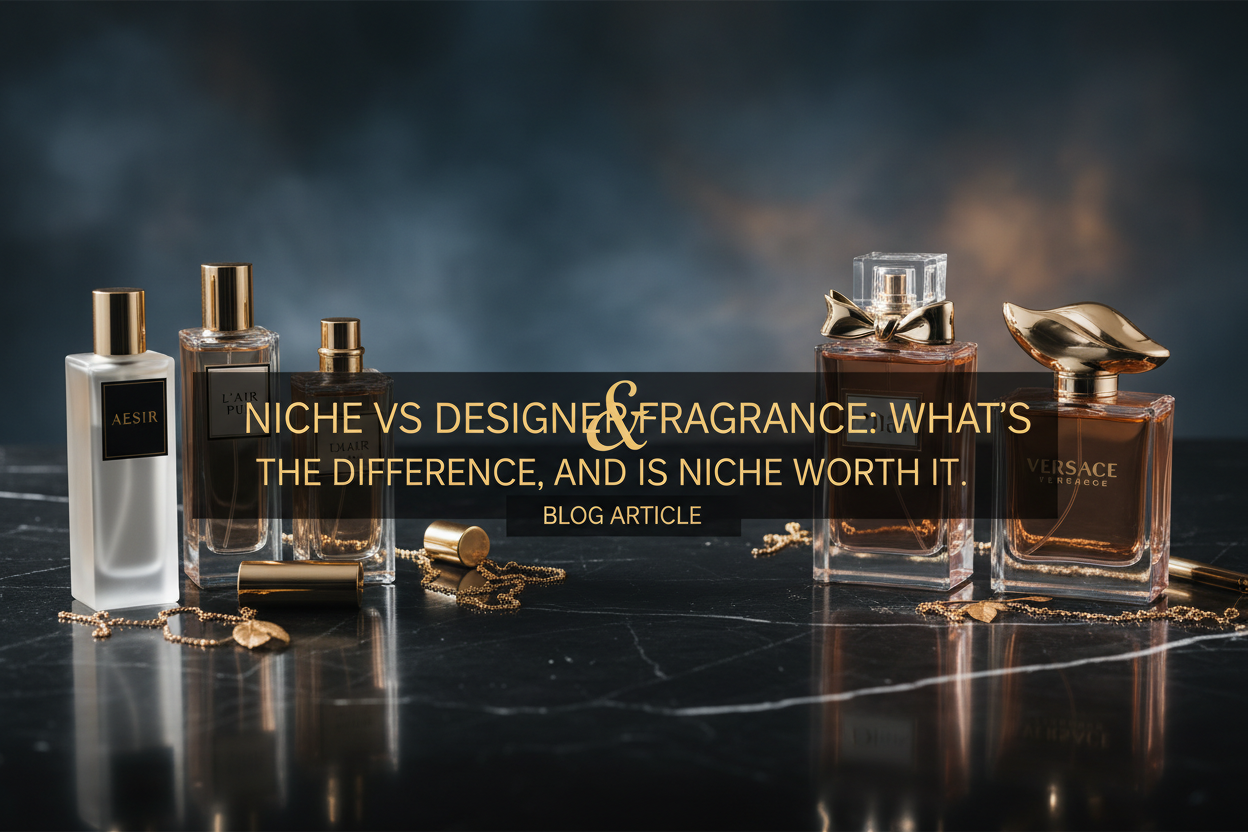
Niche vs Designer Fragrance: What's the Difference, and Is Niche Worth It?
You've seen the two words thrown around in every review and every comment section. Designer. Niche. One usually means £70. The other usually means £250. And somewhere in between sits the question nobody answers straight: is the expensive one actually better, or are you just paying for a heavier bottle and a nicer shop?
We sell fragrance for a living and we get asked this every single week. So here's the honest version, with the marketing stripped out.
By the end of this you'll know what each label really means, which differences are real and which are sold to you, where the line has quietly collapsed, and how to try a £250 scent without spending £250 to find out you hate it.
What "designer" actually means
A designer fragrance comes from a house that's known for something other than fragrance. Dior makes clothes. Chanel makes clothes and make-up. Armani, YSL, Versace, Gucci, Prada. The scent is an extension of a fashion brand you already recognise.
Here's the part most people don't know: the fashion house usually doesn't make the perfume. It licenses the name to a big beauty group. Companies like Coty, Puig, Inter Parfums and L'Oréal handle the formula, the production and the distribution. The designer signs off on the direction and the bottle.
That structure shapes everything about the final product.
Built to be liked by lots of people
A designer launch has to work in hundreds of shops across dozens of countries. It gets tested. Focus groups sniff it. Nothing too strange survives the process.
That's not an insult. Making something that thousands of different people all find pleasant is genuinely hard. But it does mean designer scents cluster around the safe middle: clean, wearable, compliment-friendly. Sauvage sold tankers of juice because it smells good to almost everybody.
Priced for volume
You'll pay roughly £60 to £130 for a 100ml designer bottle, often less at a discounter. That price works because they sell in enormous numbers, and because the marketing budget is spread across millions of units.
What "niche" actually means
A niche house makes fragrance and nothing else. No handbags, no lipstick, no runway show. Amouage, Xerjoff, Nishane, Initio, Le Labo, Frederic Malle, Maison Francis Kurkdjian.
They sell through a small number of stockists or their own boutiques. You won't find them stacked next to the tills at the airport. And the perfumer is usually named on the bottle, which almost never happens in designer.
Built to be loved by fewer people
This is the real difference, and it matters more than ingredients or price.
A niche house doesn't need everybody to like a scent. It needs a smaller group to love it enough to pay £200 plus. So the brief is looser. The perfumer gets more rope. You end up with fragrances that smell like petrol, or church incense, or wet soil after rain, because someone was allowed to make that and nobody in a boardroom said "soften it".
Some of those are extraordinary. Some are unwearable. That's the trade.
Priced for exclusivity
Expect £150 to £400 for a 50ml or 100ml bottle, sometimes far more. Small production runs genuinely cost more per unit. Ingredient budgets are often higher. But part of the price is simply the position, because being expensive is part of what the brand is selling.
We'd rather say that plainly than pretend every extra pound is in the juice.
The differences that are real
Concentration and performance
Niche skews towards eau de parfum and extrait de parfum. Designer lines carry a lot of eau de toilette. More fragrance oil in the bottle means more strength and more staying power, which is why niche gets a reputation for lasting all day.
But compare like with like and that gap shrinks fast. A designer extrait can easily beat a niche EDP. Check the concentration on the box, not the postcode of the boutique. We wrote a full breakdown of parfum vs EDP vs EDT if you want the detail.
Ingredient quality
There's something in this, though it's less dramatic than the internet claims. Niche houses often use a higher proportion of natural materials and more expensive captives, which are aroma molecules exclusive to one lab.
Where it shows up is the drydown. Cheaper formulas tend to flatten out after a few hours into something generic. Better ones keep developing. That's usually what people mean when they say something smells "expensive".
How much you'll smell like everyone else
If you wear a top-selling designer scent, you will smell like other people. That's arithmetic, not criticism. Millions of bottles are out there.
Niche buys you distinctiveness. Whether that's worth £180 depends entirely on how much you care about being recognised by your scent.
The differences that are mostly marketing
"Niche uses real ingredients, designer uses chemicals." No. Every modern fragrance at every price uses synthetic aroma molecules, and thank goodness. Synthetics gave us notes that don't exist in nature and stopped the industry stripping wild sandalwood forests bare. Naturals aren't purer, they're just different tools.
"Niche is handmade." Almost none of it is. It's made in the same kind of facility as designer, often by the same perfumers, sometimes at the same houses. Perfumers freelance. The person behind your niche obsession may well have made a supermarket bodyspray the same month.
"Niche is always more creative." It's more free, which is not the same thing. There's plenty of lazy, expensive niche riding on a nice bottle and a good story.
Where the line has quietly collapsed
Ten years ago this was a clean split. Now it's a mess, and being aware of that will save you money.
Big luxury groups bought the niche houses. Estée Lauder owns Le Labo, Frederic Malle and Kilian. LVMH owns Maison Francis Kurkdjian. Puig owns Byredo and Penhaligon's. Kering bought Creed in 2023. These are niche brands owned by exactly the sort of corporation niche was supposed to be an alternative to.
Meanwhile "niche" brands got everywhere. Parfums de Marly is sold in enough places now that calling it hard to find is a stretch. And designer houses answered by launching their own high-end lines, like Dior's Privée collection or Armani's Privé, which sit at niche prices with niche-style scents.
Then there's the Middle Eastern boom. Houses like Lattafa and Armaf sell heavy, rich, niche-flavoured fragrances for £20 to £40. They're not niche in any real sense. They're mass-market, and the materials and drydown usually give that away. But they proved that the style people associate with expensive fragrance was never actually locked behind a high price.
The label tells you less every year. Your nose tells you more.
So is niche worth it? Our honest answer
It depends on one thing: whether you'll wear it.
A £250 bottle worn three times a week for four years is good value. A £250 bottle worn four times because the opening was thrilling and the drydown was miserable is the most expensive mistake in the shop. We see the second one constantly, and it's almost always a blind buy.
Niche is worth it when:
- You've worn it properly on skin, for a full day, more than once
- You want something recognisably yours
- The style you love genuinely isn't available cheaper
Niche isn't worth it when:
- You're buying on a review, a video, or a note list
- You mostly want compliments, since designer usually wins there
- You're chasing a name rather than a smell
That first bullet is the whole game. Fragrance smells different on different people, because your skin chemistry, your body heat and even your diet change how it develops. A scent that's transcendent on a reviewer can go sour on you in twenty minutes.
How to try niche without the £250 gamble
Wear it on skin, not paper. A blotter shows you the top notes and lies about everything after. Spray your wrist and live with it for a full day, through the office, the commute, the evening.
Give it three wears before you decide. First impressions of unusual scents are unreliable. Plenty of people hate a fragrance on day one and are ordering a full bottle by day five.
And buy small first. Decants and samples are the sensible route, because you get the genuine juice in a size you can actually finish, at a price where being wrong costs a few pounds instead of a few hundred. Trying six niche scents properly at 8ml each costs less than one blind-bought bottle, and you'll learn more about your own taste in a month than a year of reading reviews.
That's the entire reason we built what we built.
The simple version
Designer is made to be liked widely and priced to sell widely. Niche is made to be loved narrowly and priced to feel special. Neither is better. The differences that hold up are concentration, drydown quality and how rare you'll smell, and the differences that don't are mostly the ones printed on the box.
Try before you buy, and the whole argument stops mattering.
Frequently asked questions
What is the difference between niche and designer fragrance?
Designer comes from a fashion or beauty house and is usually made under licence by a large beauty group, sold everywhere. Niche comes from a house that does fragrance only, sold through limited stockists. In practice the differences are distribution, price and how safely the scent plays. Designer aims at a wide crowd. Niche aims at a small one and takes more risks.
Is niche perfume better than designer?
Not automatically. Niche is usually more unusual and often stronger. Designer is better tested, easier to wear and much cheaper. A £220 niche bottle can smell worse on your skin than a £70 designer one. Better means suits you, not costs more.
Why is niche perfume so expensive?
Small production runs cost more per bottle, ingredient budgets are often higher, and the price is part of the positioning because exclusivity is what the brand sells. Marketing spend is lower than designer, but so is volume, so the saving never reaches you.
Do niche fragrances last longer than designer?
Often, mostly because of concentration. Niche leans towards EDP and extrait, designer carries a lot of EDT. Compare the same concentration and the gap narrows a long way. Check the box before you check the brand.
Is Creed niche or designer?
It sits in the middle. Creed has niche pricing and heritage but wide distribution, and it's owned by a large luxury group after the 2023 sale to Kering. Most people still call it niche out of habit.
Are niche fragrances worth the money?
Yes, if you wear them. The waste isn't the price, it's the expensive bottle used four times because it turned out to be wrong for you. Try before you commit and the maths works. Blind buy and it's a costly gamble.
What counts as a niche fragrance brand?
A house that makes only fragrance, sells through limited stockists or its own boutiques, and gives perfumers unusual freedom. Amouage, Xerjoff, Nishane, Initio, Le Labo, Frederic Malle and Maison Francis Kurkdjian are commonly listed, though several are now owned by large luxury groups.
Can you get niche quality without paying niche prices?
You can get close. Decants and samples give you the real thing at a fraction of the bottle price. Houses like Lattafa and Armaf offer scents inspired by niche hits cheaply, though the materials and drydown rarely match. And many designer releases now use the rich, heavy style niche made popular.
Do niche fragrances smell better?
They smell different more reliably than better. Niche briefs are less market-tested, so you get odder notes and scents that divide a room. If you want something nobody else is wearing, look niche. If you want compliments, designer is often the smarter buy.
Want monthly fragrance discovery without the £200 blind buys? The Vault Insider membership is built for exactly this. Start for £9 (then £19/mo), members get every drop 48 hours early, and it's love-it-or-it's-free with a 30-day money-back guarantee, cancel anytime. Start for £9 →
Read this and still not sure which scent profile fits you? Take the 60-sec scent quiz → — we'll match you to one of 5 fragrance families.