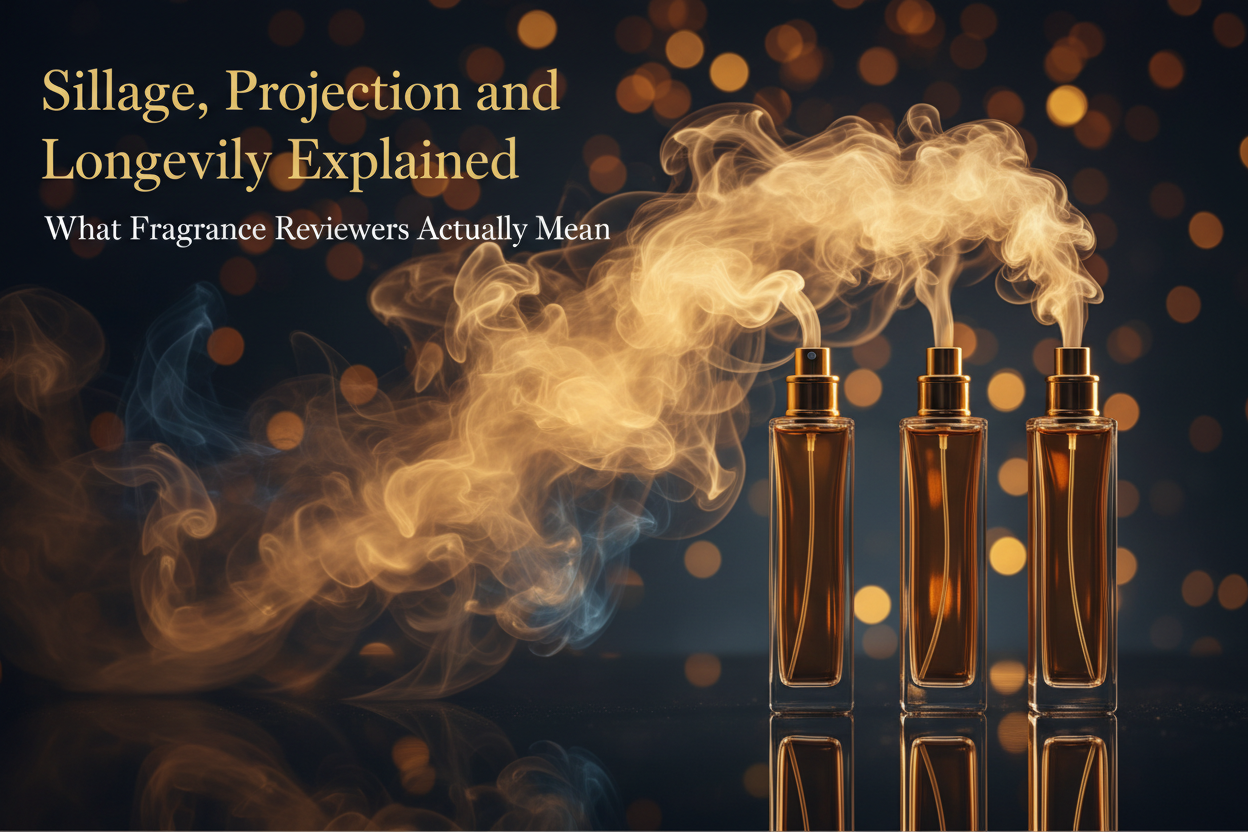
Sillage, Projection and Longevity Explained: What Fragrance Reviewers Actually Mean
Ever read a perfume review and hit a wall of words that meant nothing to you? "Killer sillage." "Beast-mode projection." "Lasts twelve hours." You just want to know if a scent smells good and sticks around. Instead you get a vocabulary lesson nobody signed you up for.
Here's the thing. Those three words, sillage, projection and longevity, are the ones that matter most when you're deciding whether a fragrance is worth your money. They describe how a scent behaves once it's on you, not just how it smells in the bottle. Get them straight and every review suddenly makes sense.
In this guide we'll break down all three in plain English, clear up the one confusion that trips everyone up, and explain why you can never smell your own perfume after an hour. By the end you'll read fragrance like someone who knows exactly what they're looking for.
The Three Words That Confuse Everyone
Let's define them fast, then dig into each one.
Longevity is how long a fragrance lasts on your skin. Two hours or twelve.
Projection is how far the scent pushes out from your skin while you stand still. The size of your scent bubble.
Sillage is the trail you leave behind as you move through a room. Your scented wake.
Three different things, and a fragrance can be strong in one and weak in another. A perfume might last all day but sit right against your skin. Another might announce you from across a room yet fade by lunch. Knowing which is which tells you how a scent will actually fit into your life.
Longevity: How Long It Lasts
Longevity is the easy one. It's simply how many hours you can still smell a fragrance on your skin before it disappears.
The biggest factor is concentration, which is the amount of actual perfume oil in the liquid. A light eau de toilette holds less oil, so it fades faster, often in three to five hours. An eau de parfum holds more and tends to run six to eight. A pure parfum, the richest of the lot, can go past eight hours and sometimes last into the next day.
Note choice matters just as much. Fresh, zingy notes like citrus, bergamot and marine accords are made of light molecules that evaporate quickly, so aquatic and summer scents naturally fade faster. Heavy materials like amber, oud, vanilla and musk are made of denser molecules that cling on far longer. That's why a cosy autumn fragrance outlasts a bright summer splash even when both are the same concentration.
What Counts as Good Longevity
There's no magic number, but here's a rough guide. Anything that carries you through a full working day is doing well. Six to eight hours from an eau de parfum is solid. If a scent survives from morning coffee to evening drinks, that's excellent performance.
If a fragrance vanishes within an hour, don't assume the bottle is faulty. Usually it's one of three things: the notes are naturally light, your skin is dry and not holding the scent, or you simply didn't apply enough. More on fixing that later.
Projection: How Far It Reaches
Projection is how far your fragrance radiates out from your body when you're standing or sitting still. Picture an invisible bubble of scent around you. Projection is how big that bubble is.
Strong projection means someone across a table can smell you clearly. This is what people mean by "beast mode", a scent that fills the space around you. Soft projection means the fragrance stays close, so people mostly catch it only when they lean in or hug you.
The Skin Scent
A fragrance with low projection is often called a "skin scent". It sits quietly against you, intimate and personal, the kind of thing only people who get close will notice. That sounds like a downside, but it isn't. Skin scents are some of the most loved fragrances out there, perfect for the office, for warm days, or for anyone who finds loud perfume a bit much.
Projection also changes over time. Almost every fragrance projects hardest in the first hour or two, when the top notes are firing, then calms down as it settles into the drydown. So a scent that felt overpowering when you sprayed it will usually mellow into something softer within the hour. Worth remembering before you decide something is "too strong" thirty seconds after spraying.
Sillage: The Trail You Leave
Now the word everyone gets wrong. Sillage is French, pronounced roughly "see-yazh", and it means wake, as in the trail a boat leaves behind it in the water. In fragrance, sillage is the scent trail you leave as you move through a space.
You've experienced sillage even if you never had a name for it. Someone walks past you in a corridor and a beautiful smell hangs in the air a second after they've gone. That's their sillage. It's the reason a fragrance can "turn heads" without being loud when you're stood right next to the person.
Sillage vs Projection: The One That Trips People Up
This is where most people tangle the two words, so let's nail it.
Projection is about you standing still and how far the scent reaches around you right now. Sillage is about you moving and the trail you leave behind you.
Here's the part that surprises people: the two don't always match. A fragrance can have modest projection, sitting fairly close to your skin, yet leave a gorgeous sillage trail when you walk past someone. Others project hard in a bubble around you but leave almost no trail once you've moved on. They're measuring two different moments. Projection is the "now". Sillage is the "after you've gone".
When a reviewer raves about sillage, they mean the fragrance leaves a memorable trail. When they praise projection, they mean it carries across a room while you're sat there. Both are good things. They just describe different superpowers.
Why You Can't Smell Your Own Perfume
Here's a puzzle that drives people mad. You spray a scent, love it, and an hour later you can't smell a thing. Panic. Did it fade already? Is the bottle weak?
Almost certainly not. What's happened is called olfactory fatigue, or nose blindness. Your brain is brilliant at ignoring smells that don't change. Once it decides a scent is constant and not a threat, it stops flagging it, freeing your nose to notice new smells instead. That's a survival feature, not a fault. It's the same reason you stop smelling your own home, or forget you're wearing deodorant.
So while you've gone nose-blind to your fragrance, everyone around you can still smell it perfectly. The scent hasn't gone anywhere. Your brain has just filed it under "already know about this".
A couple of ways to check. Ask a friend, they'll tell you straight. Or leave the room, get some fresh air, come back and catch your own wrist by surprise. You'll usually pick it up again. And a warning that follows from all this: don't keep spraying more because you can't smell it. You'll walk out wearing three times what you meant to, and everyone else will know about it.
What Changes How a Fragrance Performs on You
Two people can wear the same scent and get completely different results. That's not your imagination. A few things drive it.
Your skin. Oily, moisturised skin holds fragrance longer and lets it project better. Dry skin lets scent evaporate fast, so the same perfume that lasts all day on one person fades in two hours on another. Skin chemistry, diet and even hormones nudge how a scent smells and lasts.
The weather. Heat lifts fragrance fast, so a scent projects hard then burns off quickly in summer. Cold air slows evaporation, so the same fragrance releases slowly and lingers longer in winter. Humidity boosts projection too, which is why scents can feel bigger on a muggy day.
Concentration and notes. As covered above, a parfum outlasts a toilette, and heavy notes outlast fresh ones. If longevity matters to you, reach for a higher concentration.
How you apply it. This one's in your control, and most people get it wrong.
Getting the Most Out of Any Fragrance
You can improve performance without buying anything stronger. Here's how.
Spray onto moisturised skin. Fragrance clings to oil, so apply straight after a shower or over a splash of unscented lotion. Dry skin is the number one longevity killer.
Aim for warm pulse points: the neck, chest, and the inner elbows and wrists. The warmth of the blood beneath gently pushes the scent out through the day.
Don't rub your wrists together. Everyone does it, and it crushes the delicate top notes and can make the scent turn. Spray and let it dry on its own.
Spray a little onto your clothes or a scarf. Fabric holds fragrance for days, long after it's faded from skin, and it lifts your sillage nicely. Just patch-test first, since some oils can mark delicate materials.
Get the amount right. Too little and it dies fast, too much and you're the person people move away from. Two to four sprays suits most eau de parfums. Build up slowly until you find your number.
How to Actually Test Performance Before You Buy
Here's the honest bit. You cannot judge sillage, projection or longevity from a quick sniff in a shop. A blotter strip tells you roughly what a scent smells like for thirty seconds. It tells you nothing about how it lasts on your skin, how far it reaches, or what it becomes six hours in.
Performance is personal. The only real test is wearing a fragrance for a full day on your own skin and paying attention. Does it still project after three hours? Does it leave a trail when you move? Is it there at all by evening? That's the information that actually decides whether a bottle is worth it, and you can only get it by living with the scent for a day.
The problem is that testing properly usually means buying the full bottle first, and a designer or niche fragrance runs anywhere from £100 to £250. That's a lot to gamble on a scent that might turn out to be a two-hour skin scent when you wanted all-day projection. This is the exact gap decants close: small amounts of real fragrance you can wear for a proper day, so you learn how something performs on you before you commit to the big spend.
Once you know these three words, you know what to test for. And once you test properly, you stop wasting money on bottles that looked great in a review but did nothing on your skin.
Frequently Asked Questions
What is the difference between sillage and projection?
Projection is how far a fragrance reaches from your skin while you stand still, the bubble of scent around you. Sillage is the trail it leaves behind as you move through a room. A scent can project hard yet leave little trail, or sit close to the skin and still leave a noticeable wake when you walk past. Projection is the "now", sillage is the "after you've gone".
What is sillage in perfume?
Sillage is a French word, said "see-yazh", that means wake, like the trail a boat leaves in water. In fragrance it's the scent trail you leave behind as you move. Strong sillage means people notice you a moment after you've walked past. It's often what people mean when a fragrance "turns heads" without being loud up close.
What does projection mean in fragrance?
Projection is how far a scent radiates from your skin when you're not moving. Strong projection means someone across a table can smell it. A "skin scent" has low projection, so people mostly notice it only when they're close. Projection is usually strongest in the first hour or two, then settles as the fragrance dries down.
How long should a perfume last?
It depends on concentration. An eau de toilette might last three to five hours, an eau de parfum six to eight, and a pure parfum eight or more. Fresh citrus and aquatic scents fade faster than heavy amber, oud or gourmand. Anything that lasts a full working day is doing well. If a scent dies within an hour, it's usually the notes, dry skin or under-application, not a faulty bottle.
Why can't I smell my own perfume anymore?
That's olfactory fatigue, or nose blindness. Your brain stops registering a constant smell so it can notice new ones, which is why you lose your own scent within an hour while everyone else still smells it. It hasn't gone. Ask someone else, or catch your wrist by surprise a few hours later, and you'll usually pick it up again.
Does stronger projection mean a better perfume?
No. A room-filling beast-mode scent can be too much in an office or on a date, while a softer skin scent is often more wearable and gets more compliments. The right projection depends on the setting. Louder isn't better, it's just louder.
What makes a fragrance last longer on skin?
Moisturised skin holds scent far better than dry skin, so apply after a shower or over unscented lotion. Spray warm pulse points, don't rub your wrists together, and put a little on your clothes since fabric holds fragrance for days. Higher concentrations and heavier notes last longer, and cool air makes a scent linger.
How can I tell how a fragrance performs before buying a full bottle?
Wear it, don't just sniff it. Performance is personal, so the only reliable test is a full day on your own skin: spray in the morning and watch projection, sillage and longevity through the day. A paper strip tells you almost nothing about how it lasts on you. Testing a small decant over a real day, before spending £100 to £250, is exactly what a discovery membership is for.
Want monthly fragrance discovery without the £200 blind buys? The Vault Insider membership is built for exactly this — start for £9 (then £19/mo), members get every drop 48 hours early, and it's love-it-or-it's-free with a 30-day money-back guarantee, cancel anytime. Start for £9 →
Read this and still not sure which scent profile fits you? Take the 60-sec scent quiz → — we'll match you to one of 5 fragrance families.