Parfum vs EDP vs EDT vs Cologne: What the Numbers on Your Bottle Actually Mean (2026)
You've spent £100 on a beautiful bottle of fragrance. Wonderful. But before you spray, let's settle one thing.
What do those tiny letters on the front actually mean?
EDP. EDT. Parfum. Cologne. Eau Fraîche.
You see them everywhere — on shop shelves, in adverts, slapped across the front of bottles like they're meant to mean something to you. And nobody ever bothers to explain.
So here's the truth.
These letters change how strong your fragrance is. How long it lasts. How loudly it announces you in a lift. And — yes — how much you should pay.
We're going to walk you through every concentration, what it actually does on your skin, and how to stop overpaying for the wrong one. By the end of this guide you'll never be confused at a fragrance counter again.
Let's go.
Quick Answer
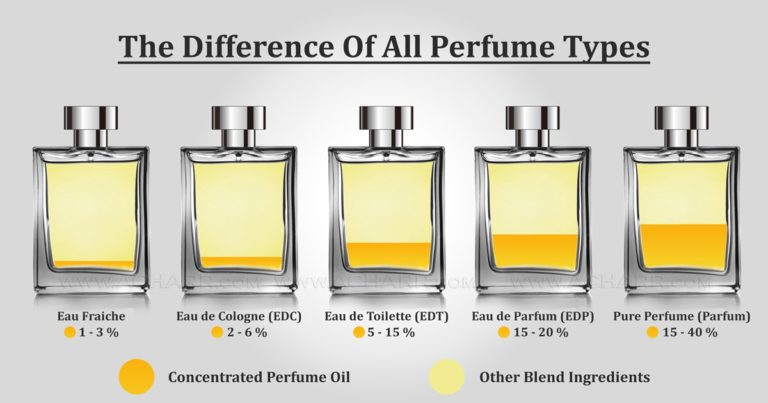
Parfum (or Extrait): strongest. 20–40% oil. Lasts 8–12+ hours. Sits close to skin. Most expensive per ml.
Eau de Parfum (EDP): strong. 15–20% oil. Lasts 6–10 hours. Projects well. The all-rounder.
Eau de Toilette (EDT): lighter. 5–15% oil. Lasts 3–6 hours. Bright, fresh, easy to wear.
Eau de Cologne (EDC): light. 2–4% oil. Lasts 2 hours. Citrus refreshers, splash-and-go.
Eau Fraîche: lightest. 1–3% oil. Lasts 1–2 hours. Hot weather only.
Higher concentration = longer wear. But concentration is NOT the same thing as quality. We'll get into that.
So What Is Fragrance Concentration, Actually?
Every bottle of fragrance is a mix of three things: perfume oil, alcohol, and a small amount of water.
That's it. That's the whole formula.
The "concentration" is just the percentage of perfume oil in that mix. The rest is alcohol — which acts as a carrier. The alcohol evaporates almost the second it hits your skin, leaving the oil behind to do its job.
More oil = more scent on your skin. Less oil = less scent.
It's that simple.
But here's where it stops being simple. Different types of oil behave very differently. Some evaporate fast (citrus, light florals). Some cling for hours (oud, vanilla, musk, amber). So a fragrance can be highly concentrated and still fade quickly — if it's built from the wrong ingredients.
We'll come back to this. But hold that thought.
Parfum (Extrait de Parfum / Pure Perfume)
Concentration: 20–40% perfume oil
Wear time: 8–12 hours, sometimes much longer
Projection: Quiet. Sits close.
Price: The highest, by a long way.
Parfum is the boss tier.
This is what perfumers reach for when they want to make a statement that lasts a full day without you ever needing to top up. The oil concentration is so high that one or two dabs on the wrist will outlast most full sprays of an EDT.
But here's the thing nobody tells you about Parfum.
It doesn't shout.
Most beginners assume the strongest concentration means the loudest scent. Wrong. Parfum tends to wear intimately — it lives in the half-metre around your skin. People will smell it when they hug you. They won't smell it across the room.
That's not a flaw. That's the design.
If you want a scent that wraps you up, lasts all day, and feels luxurious enough to be a quiet flex — Parfum is the answer. If you want to enter a room and have everyone turn around — Parfum probably isn't.
Best for: Evening wear. Special occasions. Skin chemistry that runs warm. Anyone who wants longevity over projection.
Eau de Parfum (EDP)
Concentration: 15–20% perfume oil
Wear time: 6–10 hours
Projection: Strong. Announces itself.
Price: Mid-to-premium.
If we had to pick ONE concentration to recommend to everyone — it's EDP.
EDP is the all-rounder. The Goldilocks zone. Strong enough to last most of a working day. Loud enough to be noticed. Cheap enough that you can actually afford to use it daily.
Almost every modern designer and niche release lands here as the default.
When you see "Dior Sauvage Eau de Parfum" or "MFK Baccarat Rouge 540 Eau de Parfum" — that's the version they want most people to buy. EDP is the workhorse.
A solid EDP gives you projection (the cloud around you), longevity (how many hours), and sillage (the trail you leave when you walk away). All three. That's why it dominates the market.
Best for: Daily wear. Office. Date night. Most occasions, most seasons. If you only own one fragrance — make it an EDP.
Eau de Toilette (EDT)
Concentration: 5–15% perfume oil
Wear time: 3–6 hours
Projection: Light to moderate.
Price: Cheaper than EDP.
EDT is where things get misunderstood.
A lot of beginners write off EDTs as "weaker" or "lower quality." That's lazy thinking.
EDT was the original concentration that made fragrance wearable for everyday life. Most of the great classic scents — your Dior Eau Sauvage, your Guerlain Habit Rouge, your Chanel Pour Monsieur — were created as EDTs and are still loved as EDTs.
Why? Because lighter concentrations let bright top notes — citrus, herbs, fresh florals — actually breathe. An EDT smells more like "you with a hint of something gorgeous." An EDP can smell more like "the fragrance is wearing you."
EDTs are made for daytime, for warm weather, for the kind of wear where you want to smell good but you don't want to dominate the room.
Best for: Summer. Office in close quarters. Daytime. Lighter, fresher styles. Anyone who finds EDPs overwhelming.
Eau de Cologne (EDC)
Concentration: 2–4% perfume oil
Wear time: 1–2 hours
Projection: Soft.
Price: Affordable.
Forget what you think "Cologne" means.
In British English (and in marketing), "cologne" is often used loosely to mean "fragrance for men." That's not what Eau de Cologne actually is.
Real EDC is a very light, citrus-forward style invented in the 18th century — Cologne, Germany — designed to be splashed on liberally after bathing. Think Roger & Gallet, 4711, Acqua di Parma's original Colonia.
It's bright. It's clean. It's fleeting. You're meant to use a LOT and reapply throughout the day.
If you've ever sprayed an EDC and wondered why it disappeared in an hour — that's not a fault. That's the entire point of the format.
Best for: Hot weather. Post-workout. After-shower freshness. Anyone who likes a fresh, clean, undemanding scent.
Eau Fraîche
Concentration: 1–3% perfume oil
Wear time: 1–2 hours
Price: Cheap.
The lightest format of all. Often diluted with water rather than just alcohol. Designed for very hot climates.
Honestly? Most people don't need an Eau Fraîche. It's a niche format. If you live in the UK and you want a light summer scent, an EDT will do the job better. We mention it for completeness.
The Big Myth: Stronger ≠ Better
Here's the lie that costs people the most money.
"Parfum is the best version. Always pay extra for Parfum."
No.
A well-made EDT will outperform a badly-made Parfum every single time. Concentration is just one variable. The ingredients themselves matter more.
A bright, citrus-led perfume will always fade faster than a heavy oud or vanilla one — even if both are labelled the same way. Why? Because citrus molecules evaporate within minutes. Oud and vanilla cling for hours. The note pyramid matters more than the percentage.
We've smelled £30 EDTs that last 8 hours. We've smelled £200 Parfums that fade in 4. The label tells you part of the story. Never the whole story.
The real test is on YOUR skin. Not in the bottle.
This is why we built the Vault around discovery rather than blind buys. You shouldn't have to gamble £150 to find out if a fragrance suits you. You should be able to live with it for a month, on your skin, in your real life — before you commit.
Concentration vs. Performance — Which Should You Trust?
If you only remember one thing from this guide, make it this.
Concentration tells you how much oil is in the bottle. Performance tells you what that oil does on your skin. They are not the same thing.
When you look at a fragrance, check three things:
- Concentration (the label — Parfum, EDP, EDT, EDC).
- Note pyramid (top, heart, base notes — heavier base notes = longer wear).
- Skin chemistry (the only person you can test on is yourself).
A fragrance with strong base notes — woods, resins, ambers, musks, vanillas — will perform well even at lower concentrations. A fragrance built almost entirely on top notes — citrus, light florals, aldehydes — will fade fast even at high concentration.
This is also why two people can wear the same fragrance and have wildly different experiences. Skin pH, body heat, even what you ate that day — all of it changes how a perfume develops.
There's no shortcut around this. Discovery is the only honest way to find what works for you.
How Much Should You Spray? (By Concentration)
Quick rules of thumb. None of these are gospel — adjust to your skin and the room you're walking into.
Parfum: 1–2 dabs on pulse points. Wrist, neck, behind the ears. Less is more.
EDP: 2–4 sprays. One on each side of the neck, one on the chest, one on a wrist if you want extra projection.
EDT: 4–6 sprays. You can be more generous. Top up at lunchtime if needed.
EDC: 6–8 sprays — and reapply when it fades. That's the entire format.
If you're wearing fragrance to the office or somewhere with people in close quarters, dial it back by 30%. If you're wearing it for a date or a night out, you can push it up.
Rule we teach every new Insider: spray, then walk through the cloud. Don't drown in it.
When to Choose Which Concentration
| Situation | Best concentration |
|---|---|
| Office (close quarters) | EDT or light EDP |
| Date night | EDP or Parfum |
| Summer / hot weather | EDT, EDC, or Eau Fraîche |
| Winter / cold weather | EDP or Parfum |
| Long flight or all-day event | Parfum |
| Quick refresh after gym | EDC |
| Daily go-to / one-bottle owner | EDP |
Not rocket science. The denser the scent, the better it holds in cold air. The lighter the scent, the better it sits in heat. The longer your day, the higher concentration you want.
What This All Means for Your Wallet
Here's the practical takeaway.
If a brand sells the same fragrance in three concentrations — Parfum, EDP, EDT — they will charge you increasingly more for each one. Parfum can cost twice as much as EDT for the same juice in the same bottle.
Sometimes that's worth it. Sometimes it's a complete waste.
The only way to know is to try the EDP first. It's the workhorse. If you love it but want more longevity for evenings, then upgrade to the Parfum. If you find it too heavy, drop down to the EDT.
But never — ever — buy a £200 Parfum without trying it on your skin first. That's the most expensive mistake in all of fragrance, and we see it constantly.
FAQ
What is the difference between Parfum, EDP, EDT and Cologne?
The difference is the concentration of perfume oil in the bottle. Parfum is the strongest (20–40%), EDP is strong (15–20%), EDT is lighter (5–15%), and EDC is the lightest of the standard formats (2–4%). Higher concentration generally means longer wear, but formulation matters just as much.
Does EDP last longer than EDT?
Usually yes. EDP typically lasts 6–10 hours on skin, EDT lasts 3–6 hours. But a well-built EDT with strong base notes can outperform a poorly-built EDP. Performance depends on ingredients, formulation and your skin — not just the label.
Is Parfum the strongest type of fragrance?
Yes. Parfum (also called Extrait de Parfum or Pure Perfume) has the highest concentration of fragrance oil and lasts the longest — often 8–12 hours or more.
Why do some EDPs perform worse than EDTs?
Because concentration only tells you how much oil is in the alcohol — not what the oil is made of. A bright citrus EDP will fade faster than a heavy oud EDT. Always check the note pyramid, not just the label.
Should I buy EDP or EDT for summer?
EDT is usually the smarter summer choice. Lighter concentrations feel cleaner in heat and project less in close quarters. For winter, the opposite — denser EDPs and Parfums hold up better in cold air.
How much fragrance should I apply by concentration?
Parfum: 1–2 dabs on pulse points. EDP: 2–4 sprays. EDT: 4–6 sprays. EDC: 6–8 sprays, refreshed through the day. The lighter the concentration, the more you need.
Is Parfum always better than EDP?
No. Parfum is denser and longer-lasting but sits closer to the skin. EDP has more lift — it announces itself in a room. Many houses release both versions of the same scent and the "better" one depends entirely on how you want to wear it.
What does Eau Fraîche mean?
Eau Fraîche is the lightest concentration — usually 1–3% perfume oil, sometimes diluted with water. Designed for hot climates and post-shower freshness. Expect only 1–2 hours of wear.
The Honest Takeaway
The label on the bottle is a starting point. Not the answer.
Concentration tells you roughly how strong a fragrance will be. The notes inside, the quality of the ingredients, and your own skin chemistry decide the rest.
Stop overpaying for "stronger." Start testing on your own skin. That's the only way to actually know.
Want to Try Before You Buy?
Want monthly fragrance discovery without the £200 blind buys? The Vault Insider membership is built for exactly this — start for £9 (then £19/mo), members get every drop 48 hours early, and it's love-it-or-it's-free with a 30-day money-back guarantee, cancel anytime. Start for £9 →
Read this and still not sure which scent profile fits you? Take the 60-sec scent quiz → — we'll match you to one of 5 fragrance families.