Article: What Is a Fragrance Dupe? Clones, Copies and Fakes, Explained
What Is a Fragrance Dupe? Clones, Copies and Fakes, Explained
You've seen the videos. A £28 bottle held up next to a £235 one, someone insisting you'd never tell the difference, thousands of comments arguing about it.
Some of those claims are true. A lot of them aren't. And most of the confusion comes from people using four words for four different things as if they all mean the same: dupe, clone, inspired-by, fake.
We sell decants of the real bottles, so you'd expect us to talk dupes down. We're not going to. Some dupes are genuinely brilliant value and we'd rather you knew which ones and why. What we want is for you to stop buying blind and start knowing what you're actually holding.
Here's how dupes are made, why the good ones get so close, why the bad ones can't, and how to tell which is which before you spend anything.
A dupe is not a fake, and the difference matters
Start here, because everything else follows from it.
A fake copies the original's name, logo, bottle and box, and tries to convince you it's the real thing. That's counterfeiting. It's illegal, it's usually sold at a price that's too good to be true, and it's made outside any safety system at all. Nobody has assessed it. Nobody has labelled the allergens. There's no way to know what's in the bottle.
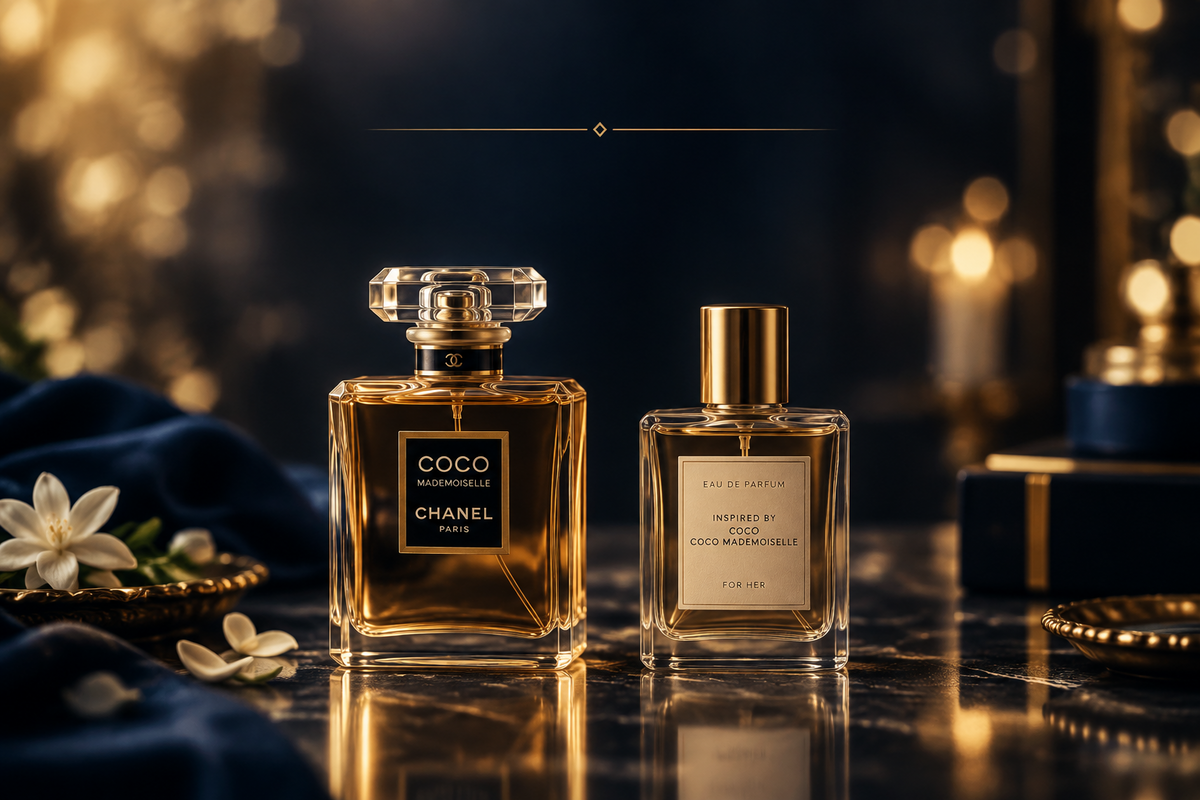
A dupe copies the smell and nothing else. It comes in its own bottle, with its own brand name on the front, and it's sold in shops and on high streets without anyone hiding anything. Lattafa Khamrah doesn't pretend to be anything other than Lattafa Khamrah.
The difference isn't a technicality. One of them is a legitimate product sitting on a shelf in Boots. The other is a crime with a health risk attached.
The vocabulary, briefly
- Clone — the maker is going for a near-identical match. Same notes, same structure, same intent.
- Inspired-by — the maker borrows the idea. Same opening accord perhaps, then it goes its own way.
- Dupe — the everyday word people use for both of the above.
- Fake — a counterfeit. Different category entirely.
Most of what's marketed as a "dupe" is really an inspired-by. True clones are rarer than the internet suggests.
Why this is legal
The reason dupes exist at all is a gap in intellectual property law that's been there for decades.
You cannot trademark or copyright a smell in the UK. You can protect a brand name. You can protect a logo. You can protect a bottle shape, a cap design, a box. You can even protect an advertising campaign. What you can't protect is the arrangement of molecules that makes a room smell of cherry and almond.
There's a practical reason as well as a legal one. Any given smell can be reached by many different routes, so even a patented formula could be worked around by a competent perfumer with a good gas chromatograph. Which is exactly what happens. A dupe house runs the original through a machine that separates out what's in it, then rebuilds it from whatever they can buy.
So the line isn't "does it smell like something else". The line is "is it pretending to be something else". Sell your own brand honestly and you're fine. Put someone else's logo on it and you're in criminal territory.
Worth knowing: the industry has tried to close this gap more than once, with mixed results across European courts, and nothing has stuck in Britain. Don't expect it to change soon.
Why some dupes nail it and others don't
This is the part almost nobody explains, and it's the single most useful thing on this page.
Modern fragrance is built from a mix of naturals (oils pressed or distilled from real plants) and synthetics (molecules made in a lab). The synthetics do most of the heavy lifting in anything you've smelled in the last twenty years, including the expensive stuff. That's not a scandal. Some of the best materials in perfumery don't exist in nature.
Here's the thing that decides whether a dupe can work.
Commodity molecules are available to everyone. Ambroxan, Iso E Super, ethyl maltol, galaxolide, the common musks. Anyone can buy them by the kilo. If a famous fragrance is built mostly on commodity molecules, a dupe house can get very close indeed, because they're working with the same box of parts.
Captive molecules are the opposite. When a fragrance house invents a new molecule, they keep it to themselves for years before anyone else can touch it. A perfumer at a rival company can smell it, identify it, and still not buy a gram of it.
That's the whole story of why some dupes are uncanny and others are a disappointment. If the signature of a perfume lives in a captive, no dupe can match it. The best a rival can do is build something in the same neighbourhood from different materials, and you'll notice. Usually in the drydown, usually around hour two, when the copy goes generic and the original keeps developing.
The second factor is naturals. Real oud, orris butter, jasmine absolute and sandalwood are eye-wateringly expensive, and they're the first thing cut. A synthetic substitute gets you most of the way for a fraction of the cost, but it tends to be flatter and less alive. This is why dupes of simple, sweet, synthetic-heavy fragrances are often excellent, and dupes of complex naturals-heavy ones rarely are.
The rough rule
Sweet gourmands, ambroxan bombs and big synthetic ambers dupe extremely well. Delicate florals, proper chypres and anything built on expensive raw materials dupe badly.
What you're actually paying for at £200
Fair question, and the answer isn't flattering to anyone.
The juice in a designer bottle is a small share of the price. The rest goes on the bottle and cap, the box, the retail margin, the celebrity face, the campaign, the licensing deal between the fashion house and the fragrance company, and the counter space in a department store.
None of that is a scam. It's how the category works, and some of it you're genuinely buying: the quality of the materials, the skill of the perfumer, the years of development, the fact that the thing smells finished in a way most cheap fragrance doesn't.
But it does explain how a house with no advertising budget, a plain bottle and a supply chain built for volume can put something similar on the shelf for £25 and still make money.
What dupes actually cost you
Now the honest part, because this is where most dupe content stops.
The opening is usually the weak point. Real citrus oils and good florals are expensive and they evaporate fastest, so they're the easiest place to save money. Plenty of dupes smell sharp, boozy or slightly plasticky for the first ten minutes before settling into something much closer to the target.
Consistency varies. Dupe houses reformulate quietly and without announcement. The bottle you loved in March might not be the bottle you get in November. Nobody tells you.
The drydown gives it away. An expensive fragrance keeps changing for hours. Many dupes reach their final form in ninety minutes and then just sit there. If you wear fragrance for yourself rather than for other people, you'll feel that.
They can overperform. Cheap long-lasting synthetics are loaded in heavily, which sounds like a win until you're the person filling a train carriage. Two sprays of a dupe is often plenty where the original would take three.
You lose the object. This matters more to some people than others, and there's no point pretending otherwise. Part of buying a nice fragrance is the weight of the bottle on the shelf. A dupe doesn't give you that, and if you care, it's a real cost rather than a snobbish one.
How to test one properly
Don't judge a dupe by the shop assistant's paper strip, and don't judge it by a video.
- Spray on skin. Paper flattens the drydown and the drydown is where dupes fail.
- One fragrance at a time. Your nose gives up after three or four.
- Wait four hours. The first ten minutes tell you almost nothing.
- Check it still holds together. A good dupe smells like one finished idea at hour three. A bad one has come apart into sweet musk and not much else.
- Ask someone else at lunchtime. You'll have gone nose blind to it by then and they won't have.
- If you can, wear the original on the other arm. Nothing else settles the argument.
And a fast honesty check before you buy anything: is the brand selling under its own name? If the bottle, the logo or the box is mimicking the original, you're not looking at a dupe. You're looking at a counterfeit, and you should walk.
The houses worth knowing
The Middle Eastern brands built this category and still dominate it. Lattafa is the one most British buyers meet first, and at its best it's remarkable value. Armaf, Al Haramain and Rasasi sit in similar territory. Strength: performance and price. Weakness: quality swings a lot between releases, and occasionally between batches of the same one.
A newer wave of British and European dupe brands tends to be steadier and more polished in that critical first half hour, but you usually pay more for it and you often lose some longevity.
The useful habit is to judge each release rather than the label. A house that made one brilliant thing has not earned your blind trust on the next one.
So where does that leave you
Dupes are a good answer to a specific question: you already know you love a scent, and you don't want to pay £200 for the bottle it normally comes in.
They're a bad answer to a different one: you're not sure yet whether you love it. Buying a 100ml dupe of something you've never worn properly is how people end up with a shelf of near-misses. The copy might be poor, or the original might not suit you at all, and you can't tell those two failures apart from a bottle you bought on a video's say-so.
That's the question decants were made for. Small amounts of the actual fragrance, worn properly over a few days, at a price where being wrong costs you the price of a coffee instead of a weekend away. Get that right first, then decide whether you want the real bottle, a good dupe of it, or neither.
FAQ
What is a fragrance dupe?
A perfume made to smell like a more expensive one, sold openly under its own brand and in its own bottle. It's not a fake. A fake copies the original's name and packaging to pass itself off as the real thing, which is illegal. A dupe copies only the smell, which nobody owns.
Are perfume dupes legal in the UK?
Yes, when sold honestly. A smell can't be trademarked or copyrighted here, so recreating a scent is fine. Copying the brand name, logo, bottle shape or packaging is trademark infringement and often a criminal offence. The test isn't whether it smells like something else. It's whether it's pretending to be something else.
What's the difference between a dupe, a clone and an inspired-by?
A clone goes for a near-identical match. An inspired-by borrows the idea without trying to copy it. Dupe is the everyday word covering both. None of them are fakes.
Why do some dupes smell almost identical and others don't?
It depends on the molecules. Some fragrances are built on materials anyone can buy, so they copy closely. Others rely on captives, which are exclusive to one fragrance house for years. If the signature lives in a captive, no dupe can match it properly.
Are dupes made with unsafe ingredients?
Cheaper, yes. Unsafe, usually not. Anything sold legally in the UK meets the same cosmetic safety rules and allergen labelling as a designer bottle. Counterfeits are the real risk, because they sit outside that system entirely.
Do dupes last as long as the original?
Often longer, which isn't always a compliment. Dupe houses load the base with cheap, powerful, long-lasting synthetics. The opening and middle are where the saving shows.
How do I tell a good dupe from a bad one?
Test on skin and give it four hours. A good one still smells like one finished idea at hour three. A bad one falls apart into generic sweet musk by the afternoon.
Is a dupe cheaper than a decant of the original?
Per millilitre, yes. But they answer different questions. A dupe gives you a lot of something close. A decant gives you a little of the actual thing. If you're still deciding whether the original suits you, the decant is the honest test.
Will people know I'm wearing a dupe?
Almost nobody can identify a fragrance by smell alone. The only real giveaway is poor performance, because a scent that turns sharp or disappears by lunchtime reads as cheap regardless of the brand.
Which houses make the best dupes?
Lattafa is the best known in the UK, with Armaf, Al Haramain and Rasasi alongside it. Great on price and performance, inconsistent between releases. Newer British and European brands are steadier but usually cost more and last less. Judge each release, not the label.
Want monthly fragrance discovery without the £200 blind buys? The Vault Insider membership is built for exactly this — start for £9 (then £19/mo), members get every drop 48 hours early, and it's love-it-or-it's-free with a 30-day money-back guarantee, cancel anytime. Start for £9 →
Read this and still not sure which scent profile fits you? Take the 60-sec scent quiz → — we'll match you to one of 5 fragrance families.