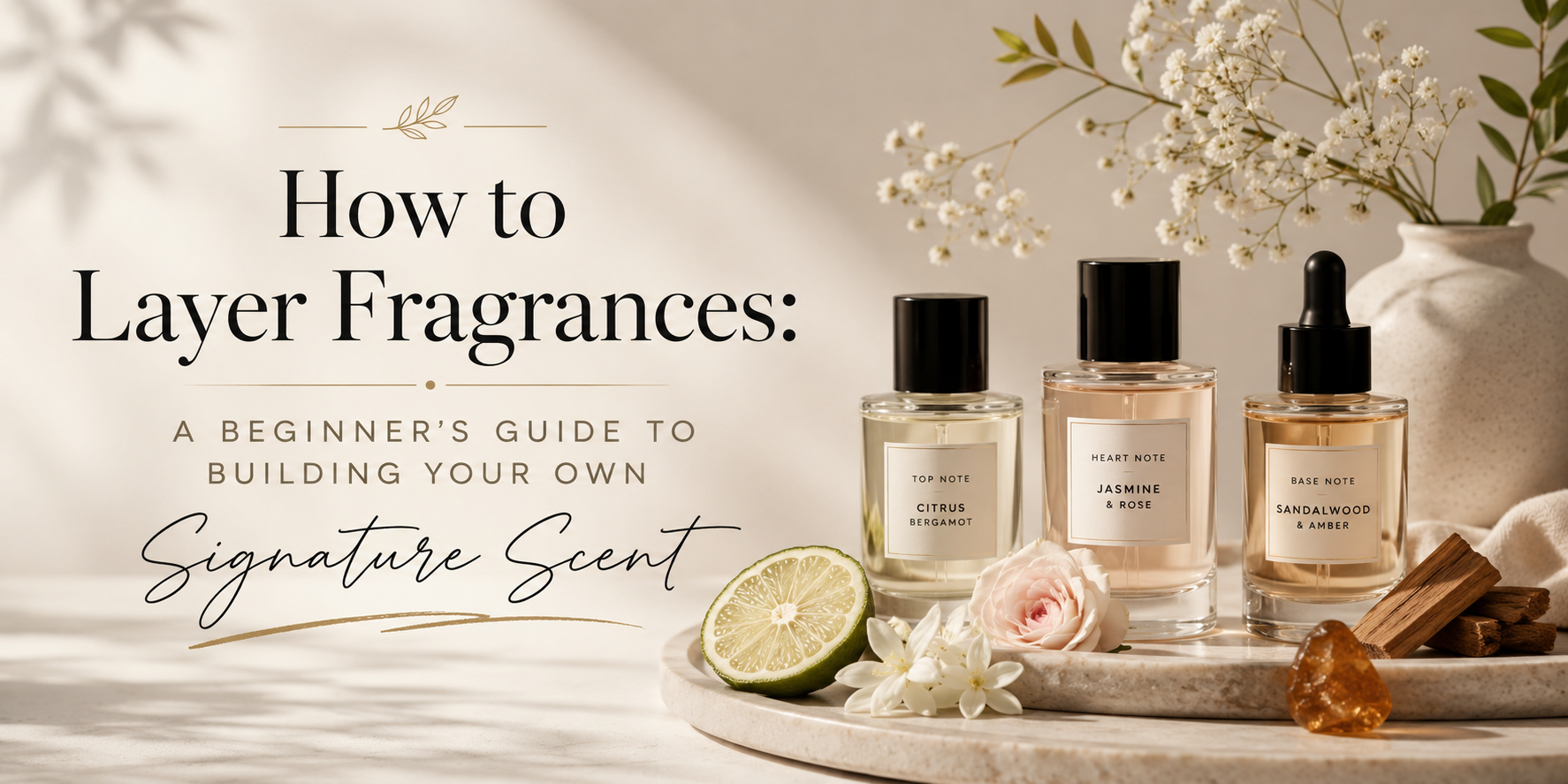
How to Layer Fragrances: A Beginner's Guide to Building Your Own Signature Scent
Ever caught a scent on someone and thought "what IS that?" — and they couldn't quite tell you? There's a good chance they weren't wearing one perfume. They were wearing two, blended on their skin into something nobody else has.
That's fragrance layering. And it's the closest thing to a cheat code that fragrance has.
Here's the problem it solves. You've got a few bottles on the shelf. You like them all. But you wear them one at a time, the same way every day, and after a while they start to feel a bit... expected. Layering takes the exact bottles you already own and turns them into dozens of new combinations — no extra spend, no blind buys, just a bit of know-how.
In this guide we'll walk you through what layering actually is, how to do it without ending up smelling like a duty-free explosion, which combinations are safe bets for beginners, and the small mistakes that quietly ruin a good blend. By the end you'll be building scents that are genuinely yours.
What Fragrance Layering Actually Is
Layering just means wearing more than one scent at the same time, on purpose, so they mix on your skin.
That's it. No special equipment. No science degree.
When two fragrances sit on warm skin together, they don't stay separate. They melt into each other and create a third smell — one that's a bit of both and not quite either. Do it well and you get depth, personality, and a scent that's much harder for anyone to place or copy.
You can layer in a few ways:
Two perfumes together. The most common and the most fun. One bottle leads, the other supports.
A scent "wardrobe" from the shower up. Scented body wash, then a matching or complementary lotion, then perfume on top. Each layer reinforces the last, and the whole thing lasts longer.
A single scent, boosted. Even pairing an unscented moisturiser under your perfume counts — you're layering hydration under scent so it clings better.
Most people start with the first one, so that's where we'll spend most of our time.
Why Bother Layering At All?
Three real reasons, and none of them are "because it's trendy."
You make something unique. A single popular perfume smells great — and smells the same on the hundred other people wearing it. Blend two and the odds of a scent twin drop through the floor.
You get more from what you own. Five bottles you wear solo is five scents. Five bottles you can layer is a lot more than five. It's the best-value trick in fragrance.
You stretch a scent across the day. Pair something fresh with something warm and you can go from a bright morning to a cosy evening without changing anything. The fresh notes carry you through the day, the deeper base carries you into the night.
The Beginner's Method: Six Simple Steps
You don't need to overthink this. Follow the order and you'll get it right most of the time.
1. Start with moisturised skin
Dry skin drinks perfume and spits it back out fast. A quick layer of unscented lotion (or a scented one that matches your plan) gives the fragrance something to grip. This one step does more for longevity than any expensive bottle.
2. Heaviest scent first
Put your deeper, richer fragrance down first — your ouds, ambers, vanillas, leathers. These are your foundation. They're slow, heavy, and they hold everything else up.
3. Wait about a minute
Give the first scent 30 to 60 seconds to settle before you add the next. Rushing it just smears the two together before either has found its footing.
4. Lighter scent on top
Now add your fresh, bright, or floral scent. Citrus, aquatics, light florals — these lift the blend and are the first thing people notice. Base grounds, top lifts. That's the whole balance.
5. Same spot, same pulse points
Layer both scents on the same warm zones — wrists, neck, behind the ears. These spots run warm and act like a little diffuser, gently pushing the blend out through the day. Applying both layers to the same heat is what lets them properly marry.
6. Go lighter than you think
This is the one everyone gets wrong. Layering is not "double the perfume." Use roughly half of each scent you normally would. You're aiming for a soft, close aura — not a cloud that clears a room.
How to Choose Combinations That Work
The difference between a beautiful blend and a mess usually comes down to what you paired in the first place.
Rule one: share something
The easiest wins come from scents that already have something in common — the same family or a shared note. Two warm scents. Two fresh ones. A vanilla in both. When they overlap, they blend instead of clash.
Rule one-and-a-half: or contrast on purpose
Once you're comfortable, opposites can be gorgeous — a warm gourmand under a cold, fresh scent gives you that "sweet but crisp" effect people love. The trick is that one should clearly lead and the other support, rather than two heavyweights slugging it out.
Pick a direction first
Before you spray anything, decide the mood: fresh, warm, sweet, floral, or woody. Choosing a direction stops you grabbing two random bottles and hoping. It keeps the blend cohesive.
Safe starter pairings
If you want combinations that are hard to get wrong:
- Vanilla + rose — warm, romantic, brilliant for evenings and date nights.
- Citrus + jasmine (or any soft floral) — fresh and elegant, made for daytime.
- Amber or woods + a fresh aquatic — the classic day-to-night shifter.
- Any gourmand + any woody scent — vanilla, caramel or tonka over cedar or sandalwood is almost foolproof.
- Musk + almost anything — clean musks are the great connector; they smooth rough edges between two scents that don't quite gel.
Start with one of these. Learn how it moves on your skin. Then start breaking the rules.
Layering From the Shower Up
Perfume-on-perfume is the headline act, but there's a quieter version of layering that gives you the best staying power of all: building your scent from the shower up.
Match your products
The idea is simple. Instead of a random shower gel, a random deodorant, and then your perfume on top all pulling in different directions, you pick products that point the same way. A vanilla body wash, a vanilla-friendly lotion, then your warm perfume — each step reinforces the next instead of muddying it.
You don't need a matching set from one brand (though those exist). You just need everything to sit in the same rough family. A clean musk body lotion under almost any perfume is a great, cheap place to start.
Why it lasts
Scent fades fastest off bare skin. When you've laid down a scented base underneath, the perfume has backup — as the top fades, the layers beneath keep quietly working. It's the difference between a scent that's gone by lunch and one that's still with you at dinner.
Layering For the Season
One last trick worth knowing: the seasons change what works.
In hot weather, heat pushes scent out harder and faster, so lean lighter — a fresh citrus or aquatic leading, just a whisper of something warm underneath. In cold weather you can go the other way: rich, sweet, and heavy layers hold beautifully against the cold and won't feel like too much. The same two bottles can behave completely differently in July and December. That's part of the fun.
The Mistakes That Quietly Ruin a Blend
Most bad layering isn't bad taste — it's a couple of small habits.
Spraying on dry skin. The scent evaporates before it develops. Moisturise first.
Using full strength of both. Too much of everything just reads as loud and confusing. Half of each.
Rubbing your wrists together. That friction heats the skin and smashes the delicate top notes. Spray, then leave it alone and let it air-dry. The blend needs space to bloom.
Layering four or five things. Past three scents you genuinely can't tell what you're smelling anymore, and neither can anyone else. Two is plenty.
Blind-buying full bottles just to experiment. This is the expensive one. You don't need to drop £150 on a bottle to find out it clashes with the vanilla you already own. Test small first — a decant or a discovery-sized sample costs a fraction and tells you everything.
A Quick Word on Testing Before You Commit
Here's the honest truth we tell everyone: layering is trial and error. Even experts land on duds. The magic combinations come from playing around.
The catch is that "playing around" gets pricey fast if you're doing it with full bottles. Two scents don't work together? That's potentially a couple of hundred quid learning what you don't like.
That's exactly why we're so sold on discovery-sized fragrance — 8ml decants and sample sets. You get enough to wear a scent properly, layer it, live with it for a week or two, and actually decide before you ever think about a full bottle. It turns layering from a gamble into a game.
That's the whole idea behind what we do at R3VIVE. Discover first. Commit later. Never blind-buy again.
Want monthly fragrance discovery without the £200 blind buys? The Vault Insider membership is built for exactly this — start for £9 (then £19/mo), members get every drop 48 hours early, and it's love-it-or-it's-free with a 30-day money-back guarantee, cancel anytime. Start for £9 →
Read this and still not sure which scent profile fits you? Take the 60-sec scent quiz → — we'll match you to one of 5 fragrance families.
Frequently Asked Questions
What does it mean to layer fragrances?
Layering means wearing two or more scents at once so they blend on your skin into one new smell. You can layer two perfumes, or build up from a scented body wash and lotion into a perfume on top. The goal is a scent that's more personal and harder for anyone else to copy, because the exact mix is yours.
Can you layer any two perfumes together?
You can try, but not every pair works. The safest bet is to start with fragrances that share a note or a family — two warm scents like vanilla and amber, or a floral with a citrus. Two loud, complex designer scents fighting each other usually turns muddy. When in doubt, pair a simple scent with a more complex one so one leads and the other supports.
What order do you apply fragrances when layering?
Heaviest first, lightest last. Apply the deeper, richer scent (think oud, amber, vanilla) to your skin first, give it around 30 to 60 seconds to settle, then add the lighter, fresher scent on top. The heavy base grounds the blend and the lighter scent lifts it.
How many fragrances should you layer at once?
Two is the sweet spot for beginners. Three at most, and only once you know how each one behaves on its own. More than three and you lose track of what you're actually smelling — which defeats the point.
Does fragrance layering make perfume last longer?
It can. A richer, deeper blend often clings longer than a single light scent, and a moisturiser underneath gives the fragrance something to hold onto. But layering is really about smelling more interesting, not just lasting longer. Moisturised skin and pulse-point application do most of the longevity work.
Should you rub your wrists together after applying perfume?
No. Rubbing creates friction and heat that breaks down the top notes and can flatten the blend. Spray or dab, then let it dry on its own. This matters even more when layering, because you want the two scents to settle side by side, not get crushed together.
What are easy fragrance combinations for beginners?
Vanilla plus rose for something warm and romantic. Citrus plus a soft floral like jasmine for fresh daytime wear. A woody or amber scent under a fresh aquatic for an easy day-to-night shift. And almost any gourmand plays nicely with almost any woody scent. Start there, then branch out.
Can you layer fragrances of different concentrations, like an EDT and a parfum?
Yes, and it often works well. Use the stronger concentration (the parfum or EDP) as your base since it lasts longer, and the lighter EDT or cologne on top to add freshness. Just go easy on the sprays so the total doesn't become overpowering.
Is it cheaper to layer scents you already own than to buy a new perfume?
Often, yes. Layering two bottles you already have can give you a scent that feels brand new without spending a penny — one of the best ways to get more out of your collection. And testing new combinations with small decants first is far cheaper than buying full bottles just to experiment.