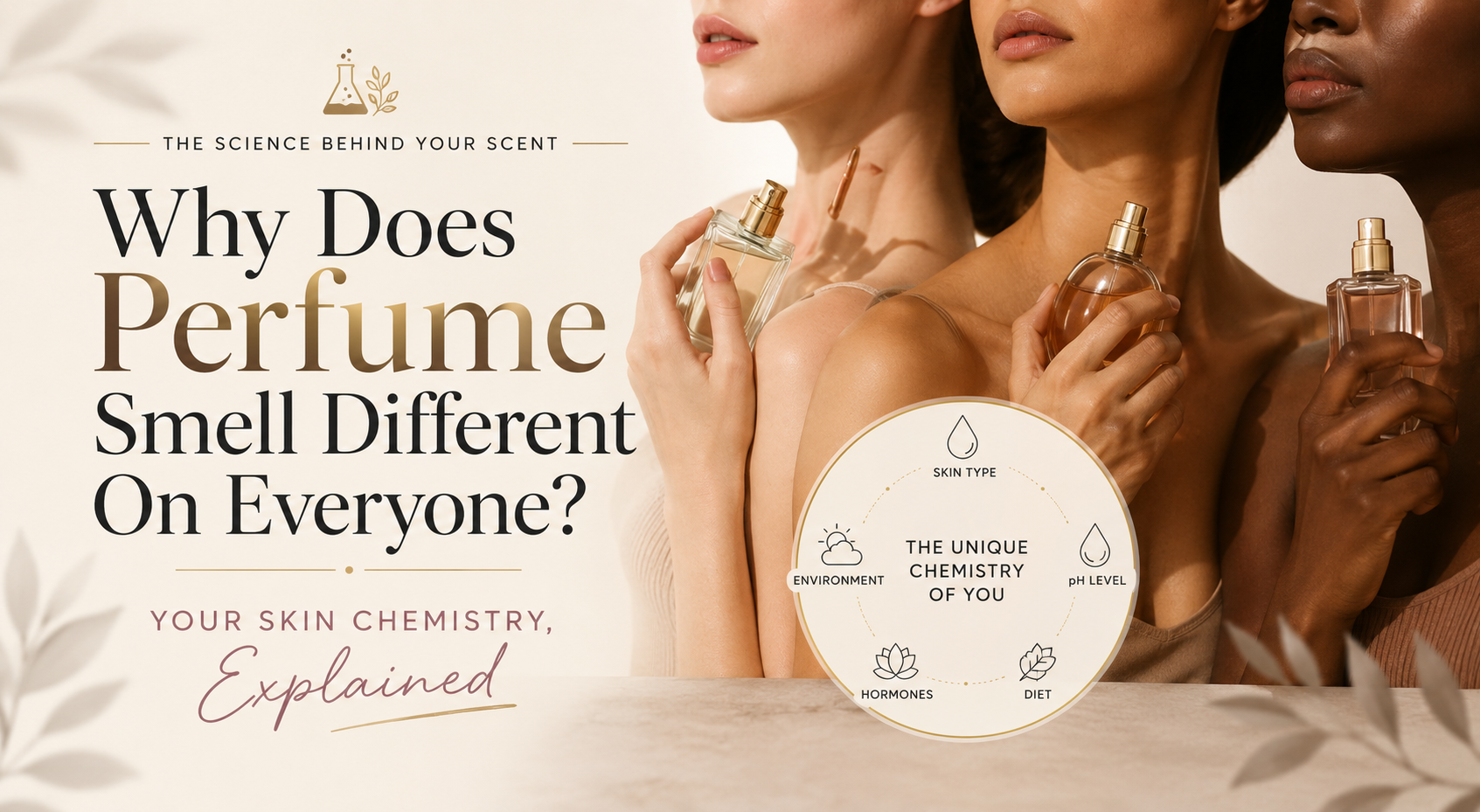
Why Does Perfume Smell Different On Everyone? Your Skin Chemistry, Explained
You smell a fragrance on a friend. It's incredible. You buy the exact same bottle, spray it on, and... it's not the same. Flatter. Sweeter. Gone in two hours. What happened?
Nothing's wrong with the bottle. The problem is that the perfume was only ever half the recipe. Your skin is the other half — and no two people's skin is the same. This is the single biggest reason blind buys go wrong, and the reason a £200 bottle can feel like a stranger on your wrist.
We've watched this play out hundreds of times with members. Same scent, wildly different results, person to person. So let's pull it apart. Here's what skin chemistry actually is, why it changes a fragrance, and how to test properly so you stop wasting money on bottles that smell great on everyone but you.
What "skin chemistry" actually means
Skin chemistry sounds like a marketing word. It isn't. It's the real mix of things on and just under your skin that a fragrance has to react with the second you spray it.
The main players:
Your natural oil, called sebum. Fragrance molecules cling to oil. More oil means more grip, so the scent lasts longer and tends to smell richer.
Your skin's pH. Skin is slightly acidic, but everyone sits at a slightly different point. That acidity changes how certain notes behave — some get louder, some get muted.
Sweat and the bacteria that live on your skin. Everyone has a personal mix of skin bacteria. It's harmless and normal, but it gives your skin its own faint base note, and the perfume sits on top of that.
Hydration. Dry skin holds less oil, so it holds less scent.
Put simply: the bottle is the same for everyone. Your skin is not. When you spray, the two meet and make something slightly new. That "something new" is what you actually smell all day.
Why the same perfume smells different person to person
Think of a fragrance as a song and your skin as the room it's played in. Same track, but a tiled bathroom and a carpeted lounge sound nothing alike. Your skin is the room.
Here's how the big differences show up.
Oily skin vs dry skin
This is the one you'll notice most. Oily skin is a magnet for fragrance. It grabs the oils, holds them, and slowly releases them — so scents last longer and often smell deeper and sweeter. If your skin runs oily, a heavy sweet fragrance can tip into too much.
Dry skin is the opposite. There's less oil to hold the scent, so it evaporates faster and reads lighter. If you've ever felt cheated because a fragrance vanished by lunch, dry skin is usually the culprit — not a weak perfume.
Warm skin vs cool skin
Heat lifts fragrance off your skin. Warmer body temperature pushes the notes out faster and stronger, which is why scents bloom in summer and on warm pulse points like your neck and wrists. Naturally warmer skin gives you a louder, faster-moving version of the same bottle.
Your skin's pH
Two people with similar oil levels can still smell different because of pH. More acidic skin can sharpen citrus and sour off some sweeter notes. It's subtle, but it's why one person gets a clean fresh opening and another gets something almost metallic from the identical spray.
The things that change YOUR chemistry day to day
Here's the part most guides skip. Your skin chemistry isn't even fixed. It shifts. The same perfume can smell different on you on a Monday versus a Friday, and you're not imagining it.
Diet
What you eat changes how your sweat smells, and your sweat sits underneath the fragrance. Garlic, spice, heavy red meat, a big night of drinking, loads of coffee — they all nudge your body's natural smell. A clean, hydrated body gives you the truest version of a scent. It's not a huge swing, but on a borderline fragrance it's enough to tip you off it.
Hormones
Hormones move your skin's oil and pH around. A menstrual cycle, pregnancy, menopause, even a stretch of bad stress — all of them can change how a fragrance develops on you. A signature scent you've worn for ten years can suddenly read differently, and the bottle hasn't changed at all. You have.
Medication and health
Some medications change your skin and your sense of smell. So can being unwell. If a trusted fragrance suddenly seems off, your body is often the reason, not the juice.
The seasons
Cold, dry winter air pulls moisture out of your skin, so fragrances fade faster and sit closer. Warm, humid summer does the reverse — scents project harder and last longer. The same EDP can feel like two different bottles in January and July.
The notes that react most to your skin
Not every part of a fragrance shifts the same amount. Some notes are stable and smell more or less the same on everyone. Others are chameleons — they swing hard depending on whose skin they land on. Knowing which is which helps you predict the surprises.
The big shape-shifters:
Musks. White musks are famous for it. On some skin they're soft, clean and gorgeous. On others they barely register at all — a chunk of people are partly nose-blind to certain musks, so a fragrance built on them can smell like almost nothing on you while everyone around you gets it loud and clear.
Ambers and ambroxan. That salty, woody, "expensive" note in half the modern designer scents leans heavily on warmth and oil. Oily, warm skin amplifies it. And like musk, some people are anosmic to ambroxan — they can't smell it well, so a scent leaning on it falls flat on them specifically.
Sweet and gourmand notes. Vanilla, caramel, tonka, anything dessert-like. Warmer, oilier skin pushes the sweetness up, sometimes into sickly territory. Cooler, drier skin keeps it tame. This is why the same sweet fragrance is "cosy and moreish" on one person and "too much" on another.
Citrus and fresh top notes. These are fast and fragile anyway, but acidic skin can sharpen or sour them, and dry skin burns them off in minutes. If you love a zesty opening, your skin type decides how long you get to enjoy it.
Woods, on the other hand — cedar, sandalwood, vetiver — tend to be steadier across different skin. If you want a safer blind-buy category, woody bases are forgiving.
How much does skin chemistry really matter? An honest take
Time for a reality check, because the internet loves to overstate this.
Skin chemistry is real, and it's the reason a scent can flatter your friend and flop on you. But it's not magic, and it won't turn a fragrance into a completely different perfume. A sweet vanilla scent will still be a sweet vanilla scent on everyone — your skin changes the volume and the angle, not the whole song.
The two things skin chemistry affects most are strength and longevity. How loud a fragrance is on you, and how long it lasts. The actual character — what family it's in, what it broadly smells like — stays mostly intact.
So don't use "skin chemistry" as an excuse to blind-buy and hope. And don't panic that every bottle is a coin flip. The honest takeaway is simpler: your skin tilts things enough that you genuinely have to wear a fragrance on it, for a real day, before you know. Not sniff it. Wear it.
What this means for buying fragrance
Now the useful bit. Once you accept that your skin is half the recipe, a few hard truths land.
A recommendation is a starting point, not a guarantee. "This one's amazing, you'll love it" tells you the fragrance is worth trying. It does not tell you how it'll behave on your skin. Influencers, mates, the bloke behind the counter — they're all describing the scent on their skin.
Smelling it on a card tells you almost nothing. A paper blotter has no oil, no warmth, no pH, no bacteria. It shows you the perfumer's intention, not your reality. Useful for a quick "do I hate this?" filter, useless for "will I wear this all day?"
The shop spray is the least honest moment of all. What you smell in the first ten minutes is the top notes — the loud, fast, fleeting opening. They burn off within the hour. The heart and base, which is what you actually live in, only show up later. Buying off the opening is like casting a film off the trailer.
This is exactly why blind buying full bottles is a gamble. You're betting £100, £200, sometimes more, that a fragrance you've never worn on your own skin will land. Sometimes it does. Often it doesn't, and the bottle ends up in a drawer.
Where you spray it matters as much as what you spray
Your skin chemistry isn't even uniform across your body. Where you put a fragrance changes how it behaves, so the same spray can give you two different results depending on placement.
Pulse points — wrists, neck, behind the ears, the inner elbow — are warmer because blood runs close to the surface there. Warmth lifts fragrance, so these spots project the scent and help it unfold. That's why "spray your pulse points" is genuinely good advice, not just a beauty-counter line.
Spraying onto clothing or hair is a different game. Fabric and hair hold scent far longer than skin because there's no oil, sweat or heat breaking it down — but they also don't let it develop the way skin does. You get longevity, you lose the warm, living version of the fragrance. Hair especially traps scent beautifully, just go easy: alcohol can dry it out.
And distance matters. Holding the bottle right against your skin gives you a wet, concentrated patch. A spray from 10–15cm away lands a finer, more even mist that smells truer and lasts more evenly. Two or three sprays is plenty for most fragrances — over-spraying doesn't fix weak longevity, it just makes you the person everyone smells before they see.
Working with your skin, not against it
You can't swap your skin chemistry. But you can stack the deck so a fragrance behaves the way you want.
Moisturise first. Unscented lotion on dry skin gives the fragrance oil to hold onto. This is the single biggest fix if your scents vanish fast. A tiny smear of plain Vaseline on a pulse point before spraying works even harder — it locks the scent down for hours.
Layer matching body products. If a fragrance comes with a matching shower gel or body lotion, using them underneath gives the perfume a foundation to sit on and stretches the longevity without you spraying more.
Match the concentration to your skin. Dry skin? Lean towards Eau de Parfum or Parfum, which carry more oil and survive longer on thirsty skin. Oily skin can get away with lighter Eau de Toilettes because it holds scent so well already.
Store the bottle right. Heat, light and big temperature swings break fragrance down. A bathroom shelf is the worst spot. A cool, dark drawer keeps the juice true for years — so the bottle isn't the variable, only your skin is.
How to test a fragrance properly on your own skin
Here's the method we'd give any member. It costs you nothing but a day.
Start clean and lightly moisturised. Unscented lotion on the spot you're testing, so the fragrance has oil to grip but nothing competing with it.
Spray onto a pulse point — inner wrist or the crook of your elbow. These run warm, which is how you'll wear it anyway.
Do not rub your wrists together. Everyone does it. It crushes the molecules and speeds up the burn-off, so you lose part of the scent before you've even smelled it properly. Spray, and leave it.
Then live with it. Smell it at 30 minutes, at 2 hours, and again after 6. You're watching the fragrance unfold from opening to heart to base. The version at hour six is the one you're really buying.
Test one, maybe two fragrances at a time. Spray six and your nose gives up — they all blur into one. And trust hour six over minute one, every single time.
The smart way to find your skin's matches
Testing properly is the answer. The catch is obvious: you can't test on your own skin for a full day from a paper sample or a 30-second sniff in a shop. And blind-buying full bottles to test them is how people end up £600 deep in a drawer of regrets.
That gap — between "I need to live with it on my skin" and "I'm not blowing £200 to find out" — is the whole reason we built R3VIVE the way we did.
You get proper amounts of carefully chosen fragrances to wear on your own skin, in your own life, across real days and real weather. You learn what your chemistry does to a citrus, a woody, a sweet gourmand — before you ever commit to a big bottle. You stop guessing. You start knowing.
That's discovery done the honest way: your skin, your call, no expensive gambles.
Frequently asked questions
Why does the same perfume smell different on different people?
Your skin's natural oils, pH, hydration, diet, hormones and even the bacteria living on your skin all change how a fragrance develops. The perfume is identical in the bottle — but your skin is the second half of the recipe. Warmer, oilier skin tends to push out sweet and woody notes and make a scent stronger. Dry skin holds less oil, so the same perfume reads lighter and fades faster.
What is skin chemistry in fragrance?
It's the mix of things on and just under your skin that interact with a fragrance the moment you spray it: natural oil (sebum), sweat, pH level, hydration, hormones, diet and your skin's bacteria. That mix reacts with the perfume oils and changes which notes you smell, how strong they are, and how long they last.
Why does perfume fade so fast on my skin?
Usually it's dry skin. Fragrance clings to oil, so if your skin is dry there's nothing for the scent to hold onto and it evaporates quickly. Moisturise with an unscented lotion before you spray and the fragrance has something to grip. Concentration matters too — an Eau de Toilette will always fade faster than an Eau de Parfum or Parfum on the same skin.
Does diet affect how perfume smells on you?
Yes. Spicy food, garlic, heavy red meat, alcohol and caffeine all change the way your sweat smells, and that sits underneath the fragrance and shifts how it reads. It's not dramatic, but a clean, well-hydrated body gives you a truer version of the scent than a hungover one.
Do hormones change how a fragrance smells?
They can. Hormone shifts during a menstrual cycle, pregnancy, menopause or even a stretch of high stress change your skin's oil and pH, and that changes how a perfume develops. A scent you've worn for years can suddenly smell different on you — and nothing's wrong with the bottle.
How do I test a perfume properly on my own skin?
Spray it on clean, lightly moisturised skin (wrist or inner elbow), don't rub it in, and live with it for a full day. Smell it at 30 minutes, 2 hours and again after 6. The opening you smell in a shop is the least honest part of the fragrance. The heart and base, hours later, are what you'll actually wear.
Why does a perfume smell amazing on my friend but bad on me?
Different skin chemistry. Their oil level, pH and warmth bring out a side of the fragrance your skin doesn't — or your skin amplifies a note theirs keeps quiet. It's the biggest reason a blind buy based on someone else's recommendation goes wrong, and the main reason testing on your own skin matters so much.
Can I change my skin chemistry to make perfume last longer?
You can't change your underlying chemistry, but you can work with it. Moisturise with an unscented lotion before spraying, aim for warm pulse points, don't rub your wrists together, and pick a higher concentration (EDP or Parfum) if your skin runs dry. Layering a matching scented body product under the perfume helps it hold, too.
Want monthly fragrance discovery without the £200 blind buys? The Vault Insider membership is built for exactly this — start for £9 (then £19/mo), members get every drop 48 hours early, and it's love-it-or-it's-free with a 30-day money-back guarantee, cancel anytime. Start for £9 →
Read this and still not sure which scent profile fits you? Take the 60-sec scent quiz → — we'll match you to one of 5 fragrance families.