What Is Vetiver? The Fragrance Note That Smells Like Earth, Smoke and Clean Skin
You have almost certainly smelled vetiver. You might not know it. It is in the base of a huge number of men's fragrances, a growing number of unisex ones, and a fair few things you would never guess, from expensive shampoo to the background of a fresh citrus scent you thought was just lemon.
The problem is that vetiver is hard to describe. Ask ten people and you will get dry soil, smoke, pencil shavings, wet grass, cold tea and burnt wood. All ten are right. It is a layered material that changes character depending on where it grew and what the perfumer did to it.
So let's take it apart. What the plant is, what the oil smells like, why one vetiver fragrance can smell like a damp cellar and another like clean laundry, and how to find your way into it without wasting money.
Vetiver is a grass, and the scent lives in the roots
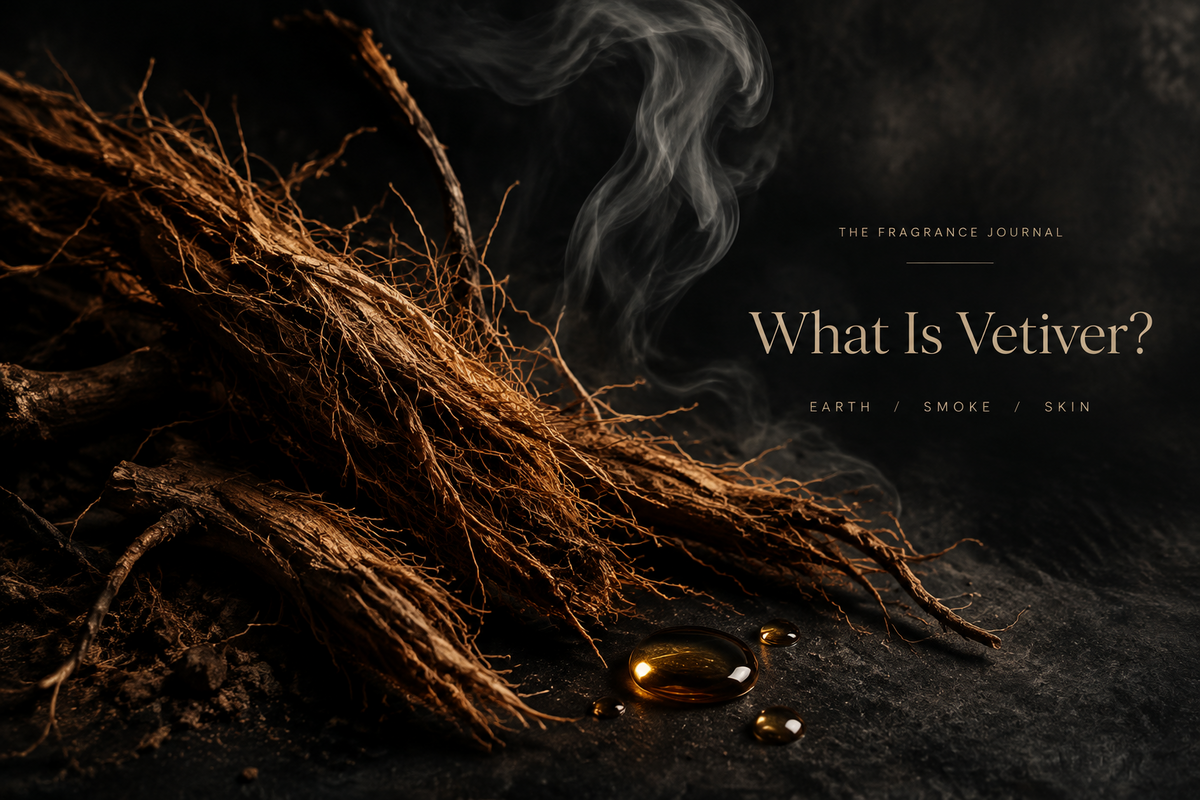
Vetiver comes from Chrysopogon zizanioides, a tall tropical grass that looks a bit like unruly lemongrass. Snap a leaf and you get very little. The scent is entirely underground.
Below the plant sits a dense, fibrous root system that can push two or three metres down. That root is what gets harvested. It takes somewhere between 18 and 24 months in the ground before it is worth digging up, and the whole plant has to come out to get it.
The roots are then washed, chopped, dried, and steam distilled over a long cycle. Yields are low. You are looking at roughly 1% oil by weight, and the distillation can run for a day or more because the heavy aromatic molecules are stubborn and come over slowly.
The result is a dark, viscous oil that smells nothing like grass.
Why the growing region matters so much
Most naturals vary by origin. Vetiver varies more than most.
Haiti produces a large share of the world's supply and its oil is generally the cleanest and brightest of the bunch. There is a grapefruit-peel quality sitting on top of the earthiness that makes Haitian vetiver much easier to build a wearable fragrance around.
Java gives you the opposite end. Indonesian vetiver is darker, smokier, more roasted. Think burnt wood, a hint of leather, sometimes something almost tarry. Perfumers use it when they want weight and shadow.
Réunion, historically the source of "Bourbon" vetiver, produced an oil that sat between the two and was prized for its richness. Production there has largely collapsed, so when you read Bourbon vetiver on a note list today, treat it as a nod to a style rather than a guarantee of origin.
India has its own tradition entirely. Wild-growing vetiver, called khus, is often distilled in copper vessels using old methods, and the oil is greener and more herbal. Khus has been used there for centuries, woven into window screens that get wet and cool the air passing through. The smell is associated with relief from heat rather than with smart menswear.
What vetiver actually smells like
Here is the honest version.
The core is dry earth. Not mud, not compost. More like soil you have turned over on a warm day, or the smell that comes off a plant pot when you move it.
Sitting on top of that is smoke and wood. Dry, ashy, closer to a cold fireplace than a bonfire. Some vetivers push this hard enough that people call them leathery.
Running through the middle is a cool green bitterness with a nutty, slightly roasted edge. This is the part that makes vetiver feel refreshing rather than heavy, and it is why the note works in hot weather when logic says an earthy wood should not.
What you will not find is sweetness. Vetiver is one of the driest materials in the perfumer's cupboard. If a fragrance built on it tastes sweet to your nose, that is coming from something else in the blend.
The chemistry, briefly
You do not need this to enjoy vetiver, but it explains a lot.
The oil is a mixture of well over a hundred compounds. The dominant one in most commercial vetiver is khusimol, which carries the woody backbone. Alpha and beta vetivone supply much of the characteristic earthy, rooty smell. Shift the ratios and you shift the whole personality of the oil, which is exactly what happens between Haiti and Java.
Vetiveryl acetate, or why "vetiver" means two different things
This one is worth understanding, because it clears up most of the confusion people have.
Perfumers can chemically modify vetiver oil through acetylation. The result, vetiveryl acetate, keeps the woody structure but loses a lot of the soil and root. It smells cleaner, fresher, tidier. Easier to wear, and much easier to slot into a bright modern composition.
So when you see vetiver on two note lists, one fragrance might be using the raw Javanese oil at high dose and the other might be using acetylated fractions with a whisper of the real thing underneath. Same word. Completely different experience.
This is not a scam. It is just how the material works. But it does mean the note pyramid tells you less than you think.
How perfumers use it
As a quiet workhorse in the base
Most of the vetiver in the world is doing invisible work. It is a natural fixative, meaning it evaporates slowly and slows down the lighter materials sitting above it. Drop vetiver under a citrus opening and the citrus lasts longer and reads richer.
Terre d'Hermès is the obvious example of this done beautifully. People describe it as an orange fragrance. The reason it has any staying power at all is the vetiver sitting under the fruit, and the tension between the bright top and the mineral base is the whole idea.
As the entire point
Then there are the fragrances where vetiver is the subject rather than the support.
The category effectively started in the late 1950s. Carven Vétiver in 1957, then Guerlain Vétiver and Givenchy Vétyver in 1959. Guerlain's is the one that stuck. It pairs vetiver with citrus and tobacco and a dusting of pepper, and it still smells like a well-made, slightly formal thing rather than a museum piece.
Frédéric Malle Vetiver Extraordinaire, composed by Dominique Ropion in 2002, took the opposite approach: massively overdose a purified vetiver and let it fill the room. It is clean, loud and a genuinely different way of hearing the note.
Lalique Encre Noire went dark instead, leaning on cypress and Iso E Super to build something inky and cold that people either adore or find bleak. Chanel Sycomore plays up the smoke. Tom Ford Grey Vetiver polishes everything smooth for a wider audience.
Smelling any three of those side by side teaches you more than this section can.
Who vetiver suits, and who should skip it
We would rather be useful than flattering here, so the honest answer.
Vetiver is probably for you if you already like dry, woody or green fragrances, you have found most sweet scents cloying, or you want something that reads as grown-up without reading as loud. It is also one of the safest bets for an office, because the dry profile rarely crowds a room.
Vetiver is probably not for you if you actively dislike the smell of soil, damp gardens or cut grass. Some people have a hard no on that family, and no amount of clever blending will fix it. There is also a generational association to be aware of: the 1959 classics were worn by a lot of men over a lot of decades, and a traditional vetiver can read as barbershop to a younger nose. That is a style question, not a quality one, but it is real.
One more, because it comes up constantly. If you tried vetiver once, hated it and wrote the note off, there is a decent chance you met a cheap version where the earthiness ran unchecked. Try a Haitian-leaning one before you close the file.
How to wear it
A few practical notes from wearing a lot of this stuff.
Apply less than you think. Vetiver has real staying power and a heavy hand turns the earthiness sour. Two sprays is usually plenty.
Put it on skin, not clothing. The note interacts well with skin warmth and the green bitterness softens as it does. On fabric it can stay flat and dusty.
Match the version to the weather. Bright Haitian-style vetivers in heat. Smoky Javanese-style ones once it turns cold. This is one of the very few notes where you can genuinely run it all year by switching the treatment rather than the note.
Give it four hours before judging. Vetiver fragrances often open at their most challenging and settle into something much rounder. The first twenty minutes is not the fragrance.
A word on where it comes from
Vetiver is one of the better sustainability stories in natural perfumery, with caveats worth knowing.
The plant is deliberately used for erosion control. Those deep roots hold soil on steep hillsides, which is why it has been planted across the tropics for reasons that have nothing to do with perfume. In Haiti, a large share of the world's supply is grown and distilled by smallholder farmers, and several of the major fragrance houses now run traceability and income programmes there.
The caveats are honest ones. Harvesting takes the whole root system out of the ground, yields are low, and farmer income rides on a world price that moves for reasons no grower controls. None of that is a reason to avoid it. It is a reason to know that a long chain of work sits behind real vetiver.
Frequently asked questions
What is vetiver in perfume?
Vetiver is an essential oil distilled from the roots of a tall tropical grass called Chrysopogon zizanioides. The leaves smell of almost nothing. All the scent sits underground, in a dense root network that takes 18 to 24 months to grow before it can be dug up, washed, dried and steam distilled. The resulting oil is dark, thick and long lasting, and perfumers use it as a base note to give a fragrance weight and grip.
What does vetiver smell like?
Dry earth, woody smoke and a cool green bitterness, with a nutty or slightly roasted edge underneath. Some people read it as damp soil after rain. Others get pencil shavings, old paper or the smell of a hot greenhouse. Almost everyone agrees it is not sweet. Haitian vetiver leans cleaner and brighter with a grapefruit peel facet. Javanese vetiver leans smokier and darker, closer to burnt wood and leather.
Is vetiver a masculine or feminine note?
Neither, though Western marketing spent sixty years insisting it was masculine. The great vetiver releases of the late 1950s were sold to men, and the category stuck. In India, where vetiver is called khus, it has always been worn by everyone and is traditionally associated with cooling down in hot weather. Modern releases have mostly dropped the label. If you like how it smells on you, it is your note.
What is the difference between Haitian and Javanese vetiver?
Growing conditions and distillation practice. Haitian vetiver is generally smoother, cleaner and a little brighter, with a citrus-peel lift that makes it easy to use in fresh compositions. Javanese vetiver is darker and smokier, with more of a roasted, leathery, almost tarry weight. Bourbon vetiver from Réunion sits between the two and is now rare enough that most references to it are historical rather than current.
How long does vetiver last on skin?
A long time. Vetiver molecules are heavy and evaporate slowly, so a vetiver base is often still detectable eight to twelve hours in, and on a blotter it can run for weeks. It also acts as a fixative, meaning it slows down the lighter materials sitting above it. That is a large part of why perfumers reach for it even when they do not want the fragrance to smell obviously of vetiver.
Why do some vetiver fragrances smell like dirt?
Because raw vetiver oil genuinely does smell earthy, and cheaper compositions do not do much to balance it. Good vetiver fragrances pair the root with something that lifts it, usually citrus, pepper, a clean musk or a fractionated material called vetiveryl acetate that strips out most of the soil and keeps the woods. If a vetiver scent reads as wet basement on you, the building is the problem, not the note.
What is vetiveryl acetate?
A modified version of vetiver oil, made by treating it so the earthy, rooty character is reduced and a cleaner woody-fresh quality comes forward. It smells tidier and less challenging than the raw oil. Most modern fresh vetiver fragrances use it, often alongside a smaller dose of natural vetiver for depth. It is worth knowing about because it explains why two fragrances can both list vetiver and smell almost nothing alike.
When should I wear vetiver?
It is one of the few notes that genuinely works year round. The cool, dry, green side makes it comfortable in heat, which is exactly why khus has been worn in Indian summers for centuries. The smoky, woody side makes the darker versions sit well in autumn and winter. For work, choose a brighter Haitian-style vetiver. For evenings and colder months, go smokier.
Is vetiver sustainable?
It is one of the better stories in natural perfumery, with caveats. Vetiver is grown largely by smallholder farmers, the plant is deliberately used to hold soil on steep slopes and prevent erosion, and Haiti supplies a large share of the world's oil. The caveats are real though: yields are low, harvesting removes the root system, and farmer income depends on a volatile global price. Several of the big fragrance houses now run traceability programmes in Haiti for exactly those reasons.
What are the classic vetiver fragrances?
Guerlain Vétiver from 1959 is the reference point almost everyone measures against, built around vetiver with citrus and tobacco. Frédéric Malle Vetiver Extraordinaire is the modern benchmark for a huge, clean vetiver overdose. Lalique Encre Noire is the famously dark, inky, cypress-heavy take. Tom Ford Grey Vetiver is the polished designer version. Chanel Sycomore leans smoky. Trying two or three of these teaches you more about the note than any article can.
The cheap way to find your vetiver
Here is the thing about a note this variable. Reading about it only gets you so far. Haitian and Javanese vetiver are described with the same word and smell like different materials, and no article can put either one under your nose.
The expensive route is buying full bottles and hoping. A bottle of one of the classics above runs anywhere from £70 to well past £200, and if the earthiness turns out not to suit you, that is an expensive lesson in a drawer.
Want monthly fragrance discovery without the £200 blind buys? The Vault Insider membership is built for exactly this — start for £9 (then £19/mo), members get every drop 48 hours early, and it's love-it-or-it's-free with a 30-day money-back guarantee, cancel anytime. Start for £9 →
Read this and still not sure which scent profile fits you? Take the 60-sec scent quiz → — we'll match you to one of 5 fragrance families.